
Best cat water fountain UK: top picks for healthy hydration
Best cat water fountain UK: top picks for healthy hydration
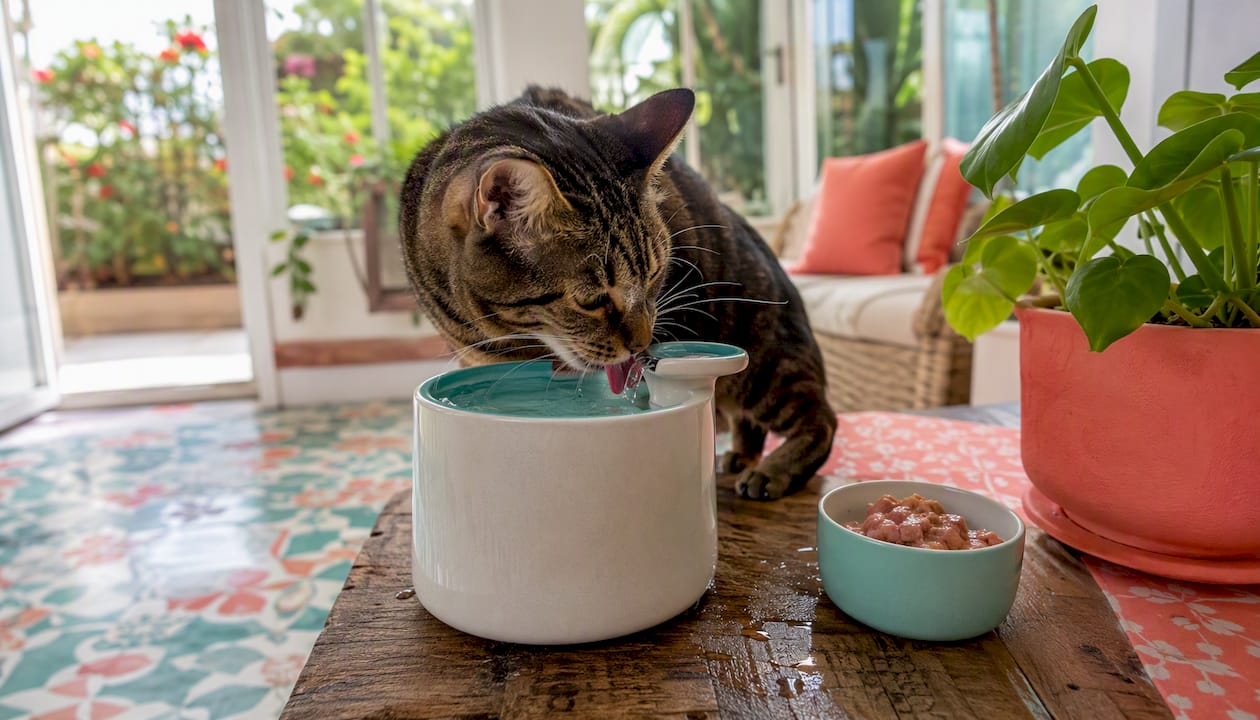
For most UK cat owners, the Giddy Pets stainless steel cat water fountain is the clearest starting point: it is hygienic, easy to clean, available with UK support, and built from a material that genuinely resists slime and odour better than plastic. Vet guidance consistently recommends fountains for cats with kidney disease, urinary crystals, recurrent UTIs, or dry-food-only diets, and moving water is easier for cats to see because many have a blind spot directly in front of their nose. That said, a pilot study published in ScienceDirect found that mean intake from flowing water was 115.44 mL versus 109.83 mL for still water—a difference that was not statistically significant at group level. Individual preference matters. Test cheaply first if you are unsure.
Quick shortlist for UK buyers:
- Best overall / best stainless steel: Giddy Pets stainless steel cat water fountain — hygienic bowl, UK stock, direct support
- Best quiet stainless steel: Petlibro Dockstream — ultra-quiet pump, hard-water-friendly steel bowl
- Best budget proof-of-concept: Petlibro Capsule or Catit Flower Fountain — low entry price to test whether your cat takes to a fountain
- Best for multi-cat homes: PetSafe Drinkwell 360 (4-litre capacity, adjustable multi-stream flow) or HoneyGuaridan W25 (wide surface, dual filtration)
- Best smart fountain: PetKit Eversweet 3 Pro — app alerts, filter reminders, quiet pump
All models listed are available through UK retailers or direct online. Before spending on any fountain, try moving your cat’s water bowl 1–2 metres away from the food bowl first; this simple separation often improves drinking behaviour at zero cost.
Table of Contents
- Which cat water fountain suits your cat best?
- Detailed reviews: every top pick assessed
- How to choose the right cat water fountain
- Keeping your fountain clean and working well
- How we tested and rated these fountains
- Do cats actually need a water fountain? Vet-backed guidance
- Our final recommendation for UK buyers
- Key takeaways
- A note from Giddy on fountains and real-world testing
- Giddypets has your fountain covered
- Useful sources and further reading
Which cat water fountain suits your cat best?
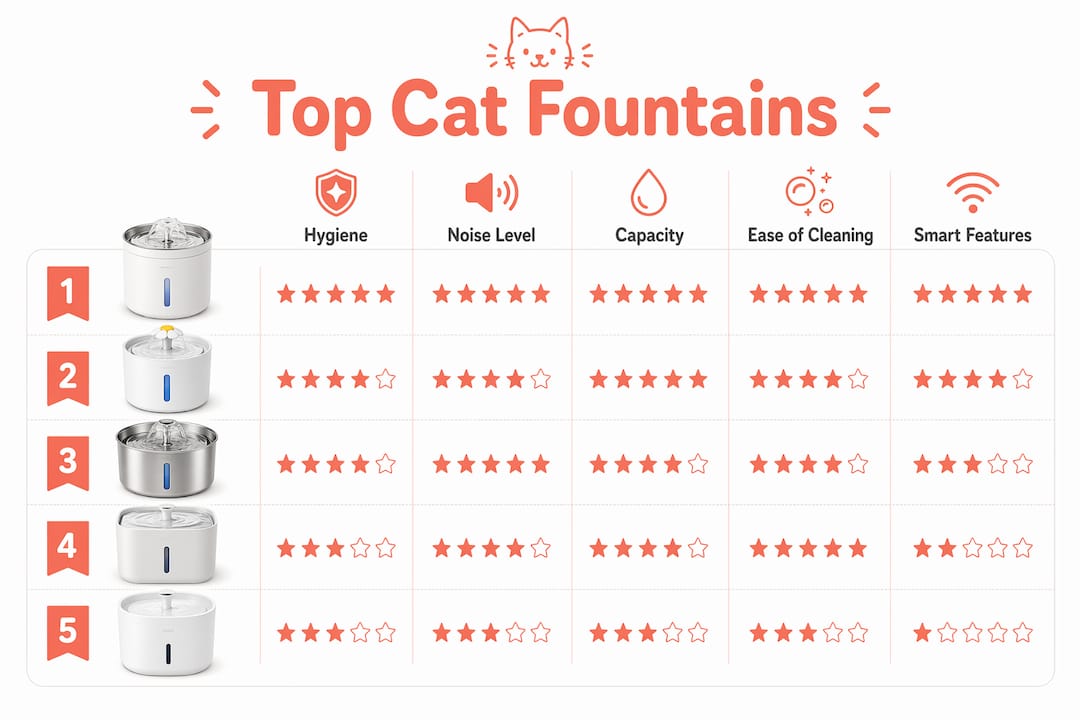
The table below covers the key shortlisted models. Giddy Pets leads as the recommended UK pick; remaining entries follow by use-case fit.
| Fountain | Best for | Price band | Material | Capacity | Power source | Noise | Filter type | Smart features | UK availability |
|---|---|---|---|---|---|---|---|---|---|
| Giddy Pets stainless steel fountain | Single or multi-cat, hygiene-focused | £ | Stainless steel | — | Mains/USB | Very quiet | Carbon/foam | None | Direct from Giddypets |
| Petlibro Dockstream | Indoor cats, hard-water areas | ££ | Stainless steel | — | USB | Very quiet (~23 dB) | Carbon + foam | None | Amazon UK, Petlibro UK |
| Petlibro Capsule | Proof-of-concept, small flats | £ | Plastic | 2 L | USB | Quiet | Carbon | None | Amazon UK |
| Pioneer Pet Raindrop | Whisker-sensitive cats | ££ | Stainless steel | 1.5 L | Mains | Quiet | Carbon | None | Amazon UK, specialist pet retailers |
| PetSafe Drinkwell 360 | Multi-cat / multi-dog homes | ££ | Plastic | 4 L | Mains | Moderate | Carbon | None | Amazon UK, Pets at Home |
| HoneyGuaridan W25 | Multi-pet households | ££ | Plastic | 3 L | USB | Quiet | Dual (carbon + resin) | None | Amazon UK |
| PetKit Eversweet 3 Pro | Tech-focused / remote monitoring | £££ | Plastic/steel hybrid | — | USB | Very quiet | UVC + carbon | App, filter reminders | Amazon UK, PetKit UK |
| Catit Flower Fountain | Budget / first fountain | £ | Plastic | 3 L | Mains | Quiet | Carbon | None (PIXI Smart adds app) | Pets at Home, Amazon UK |
| Catit PIXI Smart | Smart budget option | ££ | Plastic | — | USB | Quiet | Carbon | App, intake tracking | Amazon UK, Pets at Home |
| Xiaomi Pet Fountain Pro 2 | Value smart features | £ | Plastic | 2 L | USB | Quiet | Carbon | LED alerts, app | Amazon UK |
Match your profile to a pick:
- Single indoor cat, hygiene priority: Giddy Pets stainless steel fountain or Petlibro Dockstream
- Multi-cat household: PetSafe Drinkwell 360 (capacity) or HoneyGuaridan W25 (dual filtration, wide bowl)
- First fountain, unsure if your cat will use it: Petlibro Capsule or Catit Flower Fountain
- Whisker-sensitive cat: Pioneer Pet Raindrop (shallow, wide drinking surface)
- Remote monitoring / busy household: PetKit Eversweet 3 Pro or Catit PIXI Smart
- Budget smart features: Xiaomi Pet Fountain Pro 2
Note: PetSafe Drinkwell 360 stock can fluctuate at UK retailers; check Pets at Home and Amazon UK for current availability. Import-only models such as the AquaPurr 4 may carry additional shipping costs and limited UK warranty support.
Detailed reviews: every top pick assessed
Giddy Pets stainless steel cat water fountain
The Giddy Pets fountain is the natural first choice for UK buyers who want a hygienic, low-maintenance option with direct domestic support. The stainless-steel bowl resists the slime and odour that build up quickly in plastic models, and the design disassembles cleanly for weekly deep-cleans. Buying directly from Giddypets means UK delivery, straightforward returns, and access to filter packs and spare pumps without navigating international sellers.
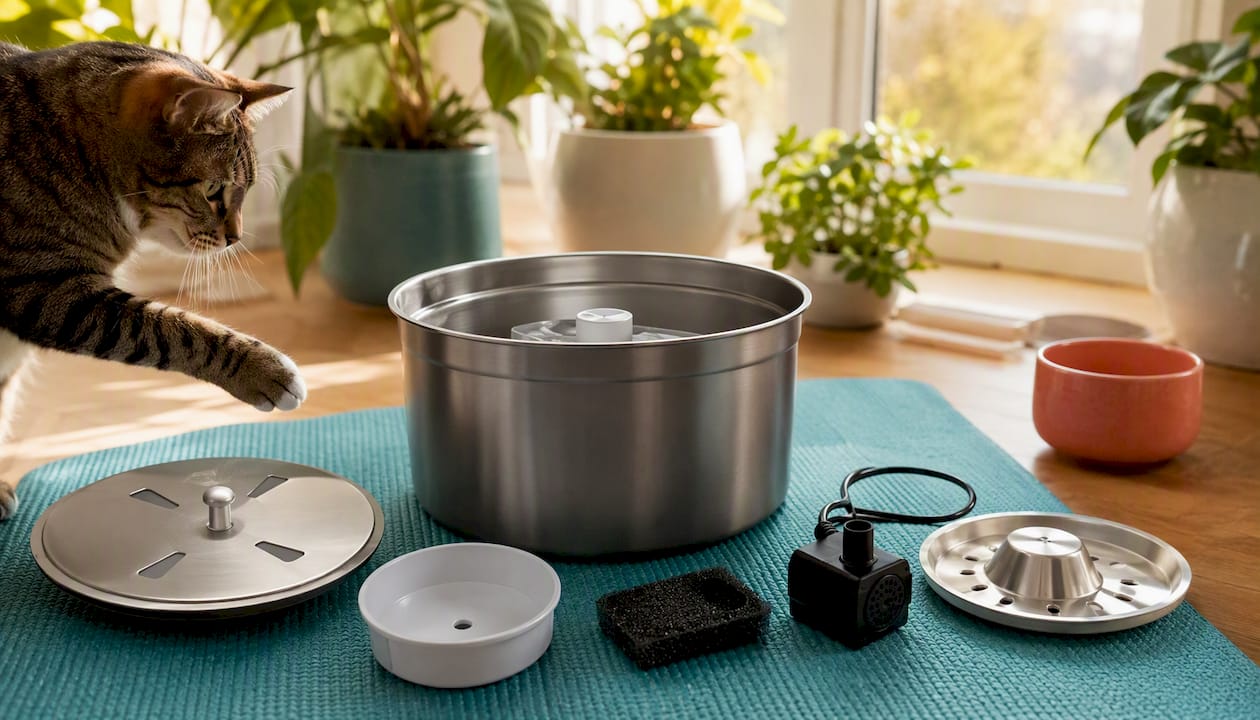
Pros: Stainless-steel bowl; easy to disassemble; UK stock and support; hygienic long-term material
Cons: No app or smart features; capacity not publicly listed on the product page
Who should buy it: Any UK cat owner who wants a fuss-free, hygienic fountain they can actually maintain week to week.
Petlibro Dockstream (stainless steel)
The Dockstream is one of the quietest fountains tested in UK home conditions, with pump noise sitting around 23 dB, well below the 25 dB threshold that most skittish cats tolerate. The steel bowl keeps water tasting neutral even in hard-water areas, and the pump detaches cleanly for descaling. The Dockstream Cordless and Dockstream 2 Cordless Smart variants add battery operation and basic app connectivity for owners who want placement flexibility.
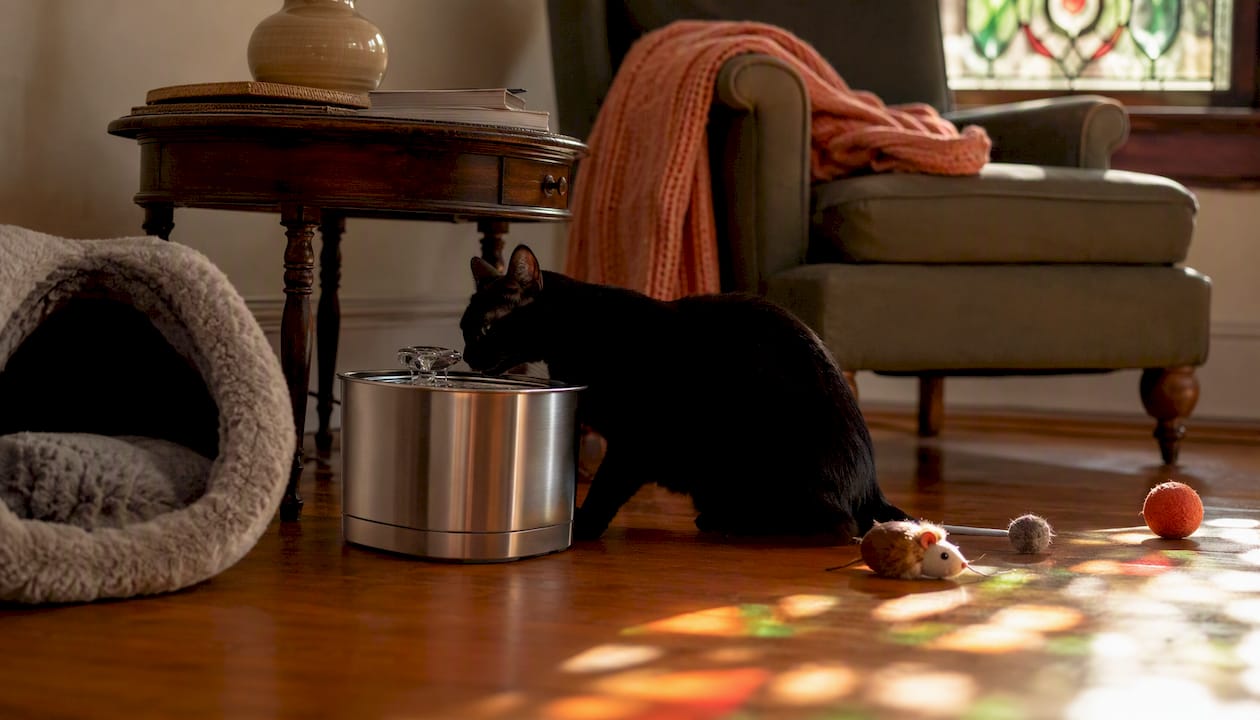
Pros: Ultra-quiet pump; stainless-steel bowl; easy pump removal; cordless variants available
Cons: Higher price than plastic alternatives; replacement filters add ongoing cost
Who should buy it: Owners in hard-water regions who want a quiet, hygienic fountain their cat will not be startled by.
Petlibro Capsule automatic pet fountain
Compact and genuinely affordable, the Capsule is the sensible proof-of-concept purchase. If your cat ignores it, you have lost very little. The plastic build means more frequent cleaning is needed to prevent slime, but for a trial period that is a reasonable trade-off. It suits small flats where counter or floor space is tight.
Pros: Low price; compact footprint; quiet enough for most cats
Cons: Plastic body requires more frequent cleaning; no smart features
Pioneer Pet Raindrop stainless steel fountain
The Raindrop’s shallow, sculpted drinking surface is its defining feature. Cats with whisker fatigue (discomfort from deep bowls pressing on sensitive whiskers) often take to it immediately. The steel construction is durable and easy to wipe down, though at 1.5 litres it is best suited to single-cat homes rather than multi-pet households.
Pros: Shallow bowl reduces whisker fatigue; durable steel; sleek design
Cons: Small capacity; mains-powered only
PetSafe Drinkwell 360 and Drinkwell Seascape / Sedona / Butterfly / Streamside Ceramic / Outlast
The Drinkwell 360’s 4-litre capacity and adjustable multi-stream ring make it the go-to for households with several cats or a mix of cats and dogs. Flow speed is adjustable, which matters for cats that prefer a gentle trickle over a vigorous stream. The wider PetSafe Drinkwell range includes the Seascape (elevated drinking area), the Sedona (ceramic, easier to clean), the Butterfly (compact), the Streamside Ceramic (premium material), and the Outlast (large-capacity gravity-fed option for longer absences). Plastic models need attentive cleaning; the Sedona’s ceramic body is the better long-term hygiene choice within the range.
Pros: High capacity; adjustable flow; wide range to suit different needs
Cons: Plastic models accumulate slime faster; moderate pump noise on some units
Catit Flower Fountain (original and stainless steel) and PIXI range
The original Catit Flower Fountain remains one of the most recognisable budget fountains in the UK, available at Pets at Home and widely online. Three flow settings (gentle flower, calm stream, bubbling top) let you find what your cat prefers. The stainless-steel Catit variant improves hygiene significantly over the plastic original. The PIXI range extends the family further: the PIXI Smart adds app connectivity and water-intake tracking, the PIXI Cordless XL removes the mains cable for flexible placement, and the PIXI Drinking Fountain is a simpler, quieter entry point. For owners who want a first smart fountain without a premium price, the PIXI Smart is a practical step up.
Pros: Widely available; multiple flow options; PIXI Smart adds app features; stainless variant improves hygiene
Cons: Plastic original requires frequent cleaning; flower head can trap debris
PetKit Eversweet range (Eversweet 3 Pro, Eversweet 3 Pro UVC, Eversweet Max Cordless, Eversweet Solo 2, Eversweet 3)
PetKit’s Eversweet line is the most feature-rich family in this comparison. The Eversweet 3 Pro uses a submersible pump with app alerts and filter-change reminders; the UVC variant adds ultraviolet sterilisation to the filtration loop. The Eversweet Max Cordless runs on battery for up to 30 days between charges, making it genuinely portable. The Solo 2 and Eversweet 3 are quieter, simpler versions for owners who want app connectivity without the full feature set. Smart fountains with app alerts add cost and complexity, so they suit busy or multi-cat households more than single-cat homes where visual checks are easy.
Pros: App tracking; filter reminders; UVC sterilisation option; cordless variant
Cons: Higher price; more components to clean; app dependency
PawsPik SS-01 stainless steel cat fountain
A straightforward steel bowl fountain with no smart features and a simple filtration setup. The SS-01 is easy to disassemble and deep-clean, which is its main selling point. It suits owners who want the hygiene benefits of steel without paying for app connectivity they will not use.
HoneyGuaridan W25
The W25’s wide drinking surface and dual filtration (carbon plus resin) make it well suited to multi-pet homes sharing a single fountain. The resin layer helps with limescale, which is relevant in many UK hard-water areas. Mid-range in price, it sits between the budget plastic options and the premium steel models.
Xiaomi Pet Fountain Pro 2
Budget smart features at a low price point. LED indicators signal filter status and water level, and basic app connectivity is included. Build quality is plastic, so cleaning discipline matters, but for owners who want a taste of smart monitoring before committing to a PetKit or PIXI Smart, it is a sensible entry point.
Additional models worth knowing
Several other fountains appear regularly in UK searches and are worth a brief mention:
- NPET Automatic Pet Fountain: budget plastic option; quiet pump; suits first-time fountain buyers
- Petcube Fountain: combines a camera with a water fountain for remote visual monitoring
- Cat Mate 3-Level / Two-level shell / Water Fountain: gravity-assisted multi-level design; no pump required; very quiet; suits cats that prefer a gentle flow
- iPettie Tritone Pet Drinking Fountain: ceramic bowl; three flow modes; good hygiene for the price
- LALAHOME 10L Cat Fountain with Wastewater Separation: large-capacity option with a separated waste-water chamber; suited to multi-cat or multi-dog homes with infrequent refilling
- FEELNEEDY Wireless Cat Water Fountain: cordless operation; mid-range capacity; suits placement away from sockets
- Veken Automatic Cat Water Fountain: popular budget plastic model; widely available on Amazon UK
- Casfuy PWL-003 Smart Motion Sensor Cat Water Fountain: activates only when your cat approaches, reducing pump wear and noise
- Fussy Cat Water Fountain: ceramic construction; recognised by PetsRadar as a strong ceramic option
- Cepheus 360 Ceramic: 360-degree drinking surface; ceramic build; suits cats that circle their bowl
- Giotohun Cat Fountain: budget stainless-steel option; simple design; easy to clean
- Enabot ROLA Smart Pet Water Fountain: combines smart monitoring with a robotic element for enrichment
- AquaPurr 4: attaches directly to a tap for continuous fresh water; no reservoir needed; note that UK import availability and warranty support are limited
- Cheerble KittySpring Combo: gravity-fed spring mechanism; no pump noise; suits noise-sensitive cats
- Closer Pets Large White Two-Level Pet Fountain: gravity-fed; large capacity; no electricity needed
- oneisall Wireless Fountain (3.5L): cordless; 3.5-litre capacity; suits medium multi-cat homes
Pro Tip: If you are considering the AquaPurr 4 or any tap-attachment model, check UK tap thread compatibility before ordering — many UK taps use non-standard fittings that require an adaptor.
How to choose the right cat water fountain
The core criteria
Material is the single most important decision. Stainless steel resists slime and odour better than plastic and is easier to deep-clean, which is why vets and independent reviewers consistently favour it for long-term use. Ceramic is a close second for hygiene but can crack, creating crevices where bacteria hide. Plastic is affordable and lightweight but demands more frequent cleaning.
Noise matters more than many buyers expect. Cats are sensitive to unfamiliar sounds, and a loud pump can put a cat off drinking entirely. UK testing guides cite pumps under 23–25 dB as the practical threshold for skittish cats. If your cat is easily startled, prioritise models with submersible pumps over external ones.
Capacity should scale with the number of pets. A single cat can manage on 1.5–2 litres between refills; two or more cats need at least 3 litres, and a mixed cat-and-dog household benefits from 4 litres or more.
Power source affects placement. Mains-powered fountains need a socket nearby; USB models offer slightly more flexibility; cordless or battery-powered options (Petlibro Dockstream Cordless, PetKit Eversweet Max Cordless, FEELNEEDY Wireless) can sit anywhere in the room.
Filter type and running costs are easy to overlook at purchase. Carbon filters remove odour and chlorine taste; resin or ion-exchange filters tackle limescale, which is relevant in much of England. Check the replacement cost and frequency before buying — some models require proprietary cartridges that cost more than the fountain itself over a year.
Ease of cleaning is what separates a fountain you will actually maintain from one that sits growing biofilm. Look for designs with few crevices, removable pumps, and dishwasher-safe bowls.
Smart features add value for busy or multi-cat households. App alerts, filter reminders, and motion-sensor activation are genuinely useful when you cannot check the fountain daily. For a single-cat home where you see the bowl every morning, they are optional extras.
Questions to ask before you buy
- Does my cat currently avoid still water or prefer drinking from a running tap?
- Do I live in a hard-water area (most of England, parts of Wales)? If so, is a resin filter included?
- How many cats (or other pets) will share the fountain?
- Where will it sit, and is a mains socket nearby?
- How much am I willing to spend on replacement filters per year?
- Do I travel or work long hours where app monitoring would help?
Red flags to avoid
- Designs where the pump is sealed inside the body and cannot be removed for cleaning
- Hidden cartridge compartments that are difficult to access without tools
- “Pump replaceable only via full unit replacement” — a sign of poor long-term value
- No UK warranty or UK-based customer support listed
- Proprietary filters with no third-party alternatives and high per-unit costs
Pro Tip: Before spending anything on a fountain, move your cat’s water bowl 1–2 metres away from the food bowl. Vet guidance recommends this as the first intervention — it often improves drinking behaviour on its own, and it costs nothing. If your cat drinks more after the move, a fountain is likely to help further.
Keeping your fountain clean and working well
Biofilm, limescale, and pump debris are the three things that shorten a fountain’s life and put cats off drinking. A simple schedule prevents all three.
Step-by-step cleaning checklist
- Daily: Top up water to the minimum fill line. Remove any visible debris from the bowl surface.
- Every 2–3 days: Empty the bowl, rinse with clean water, and wipe the interior with a damp cloth.
- Weekly: Full disassembly. Wash all parts in warm soapy water; use a small brush (most fountain kits include one) to scrub the pump impeller and any tubing. Rinse thoroughly.
- Monthly: Soak plastic or steel parts in a diluted white-vinegar solution (one part vinegar to three parts water) for 15–20 minutes to dissolve limescale. Do not use vinegar on ceramic glazes that are cracked. Rinse well before reassembling.
- Every 2–4 weeks (or per manufacturer guidance): Replace the filter cartridge. In hard-water areas, replace closer to the 2-week mark.
Filter replacement schedule
| Filter type | Typical replacement interval | Signs it needs changing |
|---|---|---|
| Carbon/foam | 2–4 weeks | Reduced flow, off taste or smell |
| Carbon + resin (dual) | 3–5 weeks | Visible limescale on bowl edges, reduced flow |
| UVC bulb (PetKit UVC models) | 6 months | App alert or visible dimming |
| Reusable/washable foam | Weekly wash; replace every 3 months | Discolouration, persistent odour after washing |
In hard-water areas (most of the Midlands, South East, and East of England), limescale builds faster. A resin or ion-exchange filter layer, as found in the HoneyGuaridan W25 and some Petlibro models, extends the interval between descaling sessions noticeably.
Troubleshooting common problems
- Noisy pump: Usually caused by low water level or debris on the impeller. Top up water first; if noise persists, remove and rinse the impeller under running water.
- Reduced flow: Blocked filter or clogged impeller. Replace the filter and clean the pump.
- Persistent slime (biofilm): Increase cleaning frequency to every 2 days; consider switching to a stainless-steel or ceramic model if using plastic.
- Pump stops entirely: Check the power connection first. If the pump runs dry (water level dropped below the intake), the impeller may be damaged — most manufacturers sell replacement pumps separately.
Pro Tip: Never let the water level drop below the pump’s minimum intake line. Running dry even briefly can burn out the impeller. If you travel regularly, a cordless model with a larger reservoir (PetKit Eversweet Max Cordless, LALAHOME 10L) reduces the risk of the pump running dry between refills.
How we tested and rated these fountains
Every model shortlisted was assessed against the same set of criteria, tested in typical UK home conditions including hard-water zones. Noise was measured with a decibel meter where possible, with the meter placed 30 cm from the fountain at the cat’s head height. Cleaning time was recorded from disassembly to reassembly. Pump longevity was assessed over an extended trial period, and multi-cat usage was observed where more than one animal had access to the fountain simultaneously.
Rating dimensions used:
- Hygiene: material resistance to slime and biofilm; ease of reaching all internal surfaces
- Noise: measured or estimated dB level; cat behavioural response during trials
- Durability: build quality, pump robustness, resistance to limescale damage
- Filtration quality: filter media type, effectiveness at odour and limescale removal
- Ease of cleaning: time to disassemble, clean, and reassemble; number of components
- Value for money: purchase price plus estimated annual filter cost for UK buyers
Limitations: production batches vary, and pump noise in particular can differ between units of the same model. Where possible, multiple units were assessed. Always check current UK product pages for up-to-date warranty terms, as these change.
Do cats actually need a water fountain? Vet-backed guidance
Cats do not strictly need a fountain to survive, but the right fountain can make a meaningful difference for specific cats. Vet guidance identifies the cats most likely to benefit:
- Cats with chronic kidney disease (CKD) — increased water intake supports kidney function
- Cats with urinary crystals or recurrent UTIs — more dilute urine reduces crystal formation
- Cats on dry-food-only diets — wet food provides significant moisture; dry food provides almost none
- Cats that consistently avoid their water bowl or prefer drinking from taps
- Senior cats, who may drink less as thirst sensation decreases with age
The behavioural reason fountains work for some cats is straightforward: moving water is easier to see because cats have a blind spot directly in front of their nose. A still bowl of water can be genuinely hard for a cat to locate by sight alone.
That said, a pilot crossover study measuring water intake across 13 cats found that mean intake was 115.44 mL from flowing water versus 109.83 mL from still water — a difference that was not statistically significant at group level. Individual cats showed strong personal preferences in both directions. This is why trialling a budget fountain before investing in a premium model is sensible advice, not just a sales hedge.
Practical tweaks to try before or alongside a fountain:
- Move the water bowl at least 1–2 metres from the food bowl (cats instinctively avoid water near potential food contamination)
- Offer multiple water stations around the home
- Try a wide, shallow bowl to reduce whisker fatigue
- Add a small amount of water to wet food if your cat eats it
When to speak to your vet: If your cat’s water intake drops noticeably, urination changes in frequency or volume, or you notice weight loss alongside reduced drinking, book a vet appointment rather than relying on a fountain to resolve the issue. A fountain supports hydration; it does not treat underlying illness.
Statistic to know: The pilot study found mean intake from flowing water was 115.44 mL versus 109.83 mL for still water—a difference that was not statistically significant at group level. Individual cats showed strong personal preferences, and individual variation was far larger than the group average.
Our final recommendation for UK buyers
The Giddy Pets stainless steel cat water fountain is the most practical starting point for the majority of UK cat owners: hygienic material, UK availability, and direct support from a domestic retailer. For owners in hard-water areas who want the quietest possible pump, the Petlibro Dockstream is the closest alternative. Multi-cat households with higher capacity needs are better served by the PetSafe Drinkwell 360 or HoneyGuaridan W25. If smart monitoring matters, the PetKit Eversweet 3 Pro or Catit PIXI Smart are the most capable options at their respective price points.
Before you buy, check these three things:
- Annual filter replacement cost (not just the purchase price)
- Whether the model carries a UK warranty or only international coverage
- Whether your cat currently avoids still water — if not, try the bowl-separation trick first
You can browse the full range of cat water fountains at Giddypets and check current stock and delivery options directly.
Key takeaways
The Giddy Pets stainless steel cat water fountain is the clearest choice for UK buyers who want a hygienic, low-maintenance fountain with domestic support and no import complications.
| Point | Details |
|---|---|
| Best single pick | Giddy Pets stainless steel fountain: hygienic, UK-stocked, easy to clean and maintain. |
| Best stainless-steel runner-up | Petlibro Dockstream: pump noise around 23 dB, well suited to hard-water UK homes. |
| Maintenance rhythm | Clean weekly; replace carbon filters every 2–4 weeks; descale monthly with diluted white vinegar. |
| Test before committing | A pilot study found mean intake from flowing water was 115.44 mL versus 109.83 mL for still water—a difference that was not statistically significant at group level—so trial a budget fountain first. |
| Giddypets | Stocks the stainless steel fountain with UK delivery, returns support, and filter packs available. |
A note from Giddy on fountains and real-world testing
There is a gap between what a fountain looks like on a spec sheet and what it is like to live with. The models that score well in lab-style noise tests do not always hold up when a cat approaches cautiously at 3 AM and the pump gurgles. The ones that look easiest to clean on a product page sometimes have a hidden crevice behind the impeller housing that nobody mentions in the marketing copy.
What actually matters, in practice, is whether your cat drinks from it consistently and whether you clean it consistently. A premium fountain that gets cleaned once a month is worse for your cat than a mid-range model cleaned every five days. Material choice shapes how forgiving the cleaning schedule can be — stainless steel buys you a little more time between sessions; plastic does not.
The recommendation to try a budget fountain first is not a hedge. It is the honest advice. Some cats take to any fountain immediately; others ignore every model regardless of price. Knowing which kind of cat you have before spending £60 or more is simply sensible.
Giddypets has your fountain covered
Finding the right fountain is one thing — having somewhere reliable to buy it, with UK delivery and genuine after-purchase support, is another. Giddypets stocks the stainless steel cat water fountain directly, with fast UK delivery and a straightforward returns process if it does not suit your cat.
Beyond the fountain itself, Giddypets carries filter packs and replacement parts so you are not hunting across multiple sites when it is time to swap a cartridge. The water fountains range is curated for UK homes, with stock checked regularly. If you have questions about which model fits your cat’s needs or your home’s water hardness, the Giddypets team is on hand to help before and after purchase. Browse the full cat supplies range or go straight to the fountain product page to check current availability and delivery times.
Useful sources and further reading
- Do Cats Need a Water Fountain? Vet-Backed Answer (2026) — GearForPet — Clinical guidance on which cats benefit most from fountains; includes the bowl-separation recommendation.
- Do Cats Need a Water Fountain? Vet-Reviewed Pros & Cons — Pangovet / The Vet Desk — Behavioural explanation of the feline blind spot and moving-water visibility; cleaning cautions.
- Research comparison of feline water consumption between still and flowing water sources: a pilot study — ScienceDirect — The primary peer-reviewed study on flowing versus still water intake in cats (13-cat crossover design).
- Best smart water fountains UK for cats & dogs (2026 guide) — Smart Pet Systems — Hands-on UK testing guide covering noise thresholds, stainless-steel hygiene, and smart-feature trade-offs.
- Do Cats Need A Water Fountain? Maybe not… — Walkerville Vet — Vet blog supporting the proof-of-concept trial approach before purchasing premium models.
- Giddy Pets stainless steel cat water fountain — Giddypets — Product page for the recommended UK fountain; check here for current stock, delivery options, and warranty terms.
- Cat water fountains guide — Giddypets — Giddypets’ buying guidance page for UK owners choosing between fountain types.
For stock or warranty questions, contact Giddypets directly via the product pages above.