

Rabbit diet guide: practical daily plan for owners
Rabbit diet guide: practical daily plan for owners
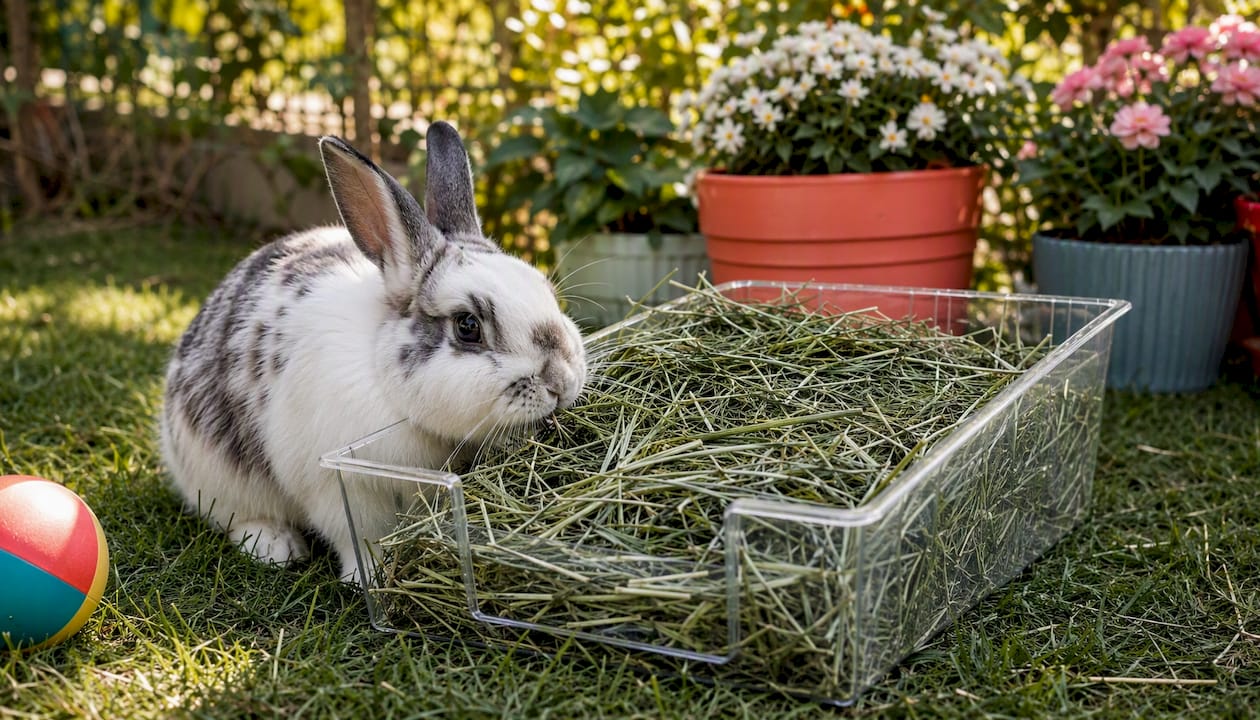
A healthy adult rabbit’s diet is built on one non-negotiable foundation: unlimited good-quality grass hay, which should make up approximately 85% of what they eat, with leafy greens covering around 10% and measured extruded pellets the remaining 5%. Get that ratio right and almost everything else falls into place.
Your daily feeding checklist:
- Hay: Always available, at least the size of your rabbit’s body in volume — never let the rack run empty
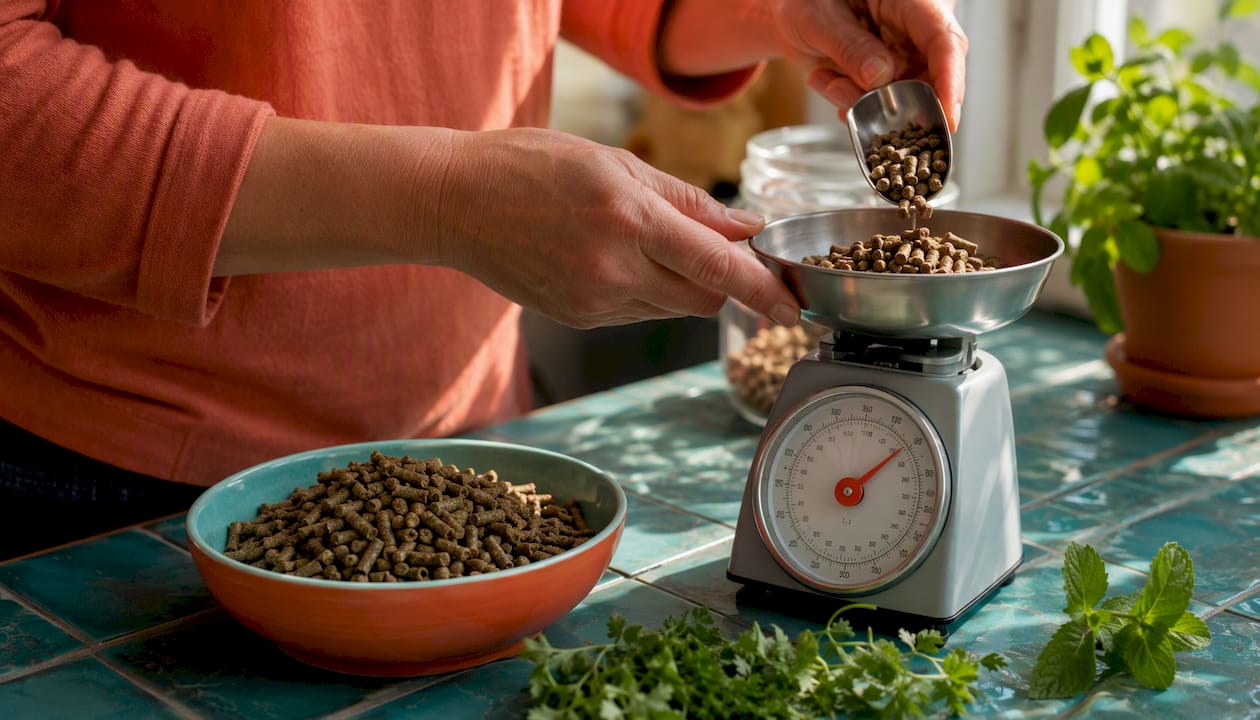
- Pellets: 15–20 g per kg bodyweight per day maximum for adults; weigh them, do not guess
- Leafy greens: A large, loosely packed handful of 5–6 different safe varieties daily
- Water: Fresh, clean water available at all times — bowl or bottle, checked twice daily
- Do not feed muesli mixes — they encourage selective eating and are directly linked to dental disease and obesity
Table of Contents
- Why hay is the most important part of your rabbit’s diet
- Which hay should you choose for your rabbit?
- How much should you feed your rabbit each day?
- What can rabbits eat, and what should you avoid?
- How to change your rabbit’s diet safely
- Adapting the diet for different life stages and health conditions
- A sample daily feeding plan and 7-day greens rotation
- Buying and storing hay and pellets: what to look for
- When should you call the vet about your rabbit’s diet?
- Key takeaways
- A note from Giddy
- Stock your rabbit’s feeding station with Giddypets
Why hay is the most important part of your rabbit’s diet
Hay is not just filler. It is the single food that keeps a rabbit’s gut moving and their teeth from overgrowing, and no amount of pellets or greens can replace it.
Rabbits are hind-gut fermenters, which means their digestive system relies on a specialised chamber called the caecum to break down plant fibre. The caecum is packed with bacteria and microorganisms that ferment fibrous material and produce nutrients the rabbit then absorbs by eating soft droppings called caecotropes directly from their bottom. Long-strand fibre from hay keeps this whole system moving at the right pace. Without it, gut motility slows, gas builds up, and the result can be gut stasis — a life-threatening condition where the digestive system effectively stops.
Dental wear is the other half of the story. A rabbit’s teeth grow continuously throughout their life, and the grinding motion of chewing hay is what keeps them worn to the correct length and angle. Soft foods simply do not provide enough resistance to do this job.
The benefits of a hay-rich diet stack up quickly:
- Supports healthy gut motility and prevents stasis
- Keeps teeth worn to the correct length and angle
- Reduces boredom through natural foraging behaviour
- Helps maintain a healthy body weight
- Enables full nutrient extraction through caecotrope production
Sudden dietary changes disrupt the delicate balance of gut bacteria in the caecum, which can trigger gas-producing bacterial overgrowth and gut stasis. This is why even well-intentioned switches — moving from muesli to pellets, or introducing a new green — need to be gradual and monitored carefully.
Which hay should you choose for your rabbit?
Most adult rabbits do best on lower-calcium grass hays: timothy, orchard grass, and meadow hay are the three you will encounter most often in UK pet shops. Alfalfa hay is a different category entirely — it is high in calcium and protein, which makes it suitable for kits (young rabbits under 7 months), pregnant does, and lactating mothers, but not for healthy adults where excess calcium raises the risk of bladder and kidney stones.
Grass hay types compared
- Timothy hay: The gold standard for adult maintenance. Moderate protein, good fibre content, and widely available in the UK. First-cut timothy tends to be higher in fibre and lower in protein, making it a good choice for weight management. Second-cut balances fibre and softness for general use. Third-cut is richer and softer, useful for underweight or elderly rabbits.
- Meadow hay: A mix of grasses and wildflowers, often with a more varied texture and aroma than timothy. Many rabbits find it more appealing, which can encourage greater hay intake. Slightly more variable in nutritional content depending on the season and supplier.
- Orchard grass hay: Softer texture than timothy, with a slightly sweeter smell. A good option for rabbits that are reluctant hay eaters, or as a mix alongside timothy.
- Alfalfa hay: High protein and calcium. For kits and reproductive does only — not for healthy adult rabbits.
Pro Tip: Try hand-packed timothy hay for adult rabbits as a reliable, consistent-quality option. Hand-sorted bales tend to have lower dust levels and better colour than bulk-packed alternatives.
What to look for when buying hay
Good-quality hay should be green to light green in colour, smell fresh and pleasant, feel soft rather than brittle, and have minimal dust. Avoid anything that smells musty, looks grey or brown, or has visible mould. Dusty hay is particularly problematic as it can cause respiratory irritation.
Never use lawn clippings as a hay substitute. Freshly cut grass ferments rapidly once bagged, producing gases that can cause serious digestive upset. Dried, commercially prepared hay is always the safer choice.
Storage tips:
- Keep hay in a breathable bag or wooden box — never sealed plastic, which traps moisture
- Store in a cool, dry place away from direct sunlight
- Check regularly for signs of mould or pest activity
- Buy in quantities your rabbit will consume within 4–6 weeks to maintain freshness
- Indoor rabbits typically need less storage volume than outdoor rabbits with larger hutches
How much should you feed your rabbit each day?
The measurable rule is straightforward: unlimited hay, plus pellets at a maximum of 15–20 g per kg of bodyweight per day, plus a large handful of mixed leafy greens. Water must be available at all times.
| Rabbit weight | Pellets per day (max) | Hay | Leafy greens |
|---|---|---|---|
| 1 kg | 15–20 g | Pile at least the size of the rabbit’s body | Small handful (approx. 30 g) |
| 2 kg | 30–40 g | Pile at least the size of the rabbit’s body | Large handful (approx. 60 g) |
| 3 kg | 45–60 g | Pile at least the size of the rabbit’s body | Large handful |
| 4 kg | 60–80 g | Pile at least the size of the rabbit’s body | Two large handfuls |
| 5 kg+ | 75–100 g | Pile at least the size of the rabbit’s body | Two large handfuls |
For rabbits above 4 kg, measured extruded pellets should be fed at a maximum of 15–20 g per kg bodyweight per day — weigh carefully to avoid overfeeding.
Weigh pellets with a kitchen scale rather than estimating by eye — it takes seconds and makes a real difference to weight management. A rabbit that fills up on pellets will eat less hay, which is the opposite of what you want.
Hay racks placed at nose height encourage natural foraging posture and keep hay clean. Scatter some hay on the floor of the enclosure too, as many rabbits enjoy rooting through a loose pile.
Pro Tip: When choosing pellets, look for high-fibre extruded pellets with a crude fibre content of 18–22% or higher. Avoid any pellet that contains seeds, nuts, or dried fruit — these drive selective eating and push calorie intake up without adding useful nutrition.
What can rabbits eat, and what should you avoid?
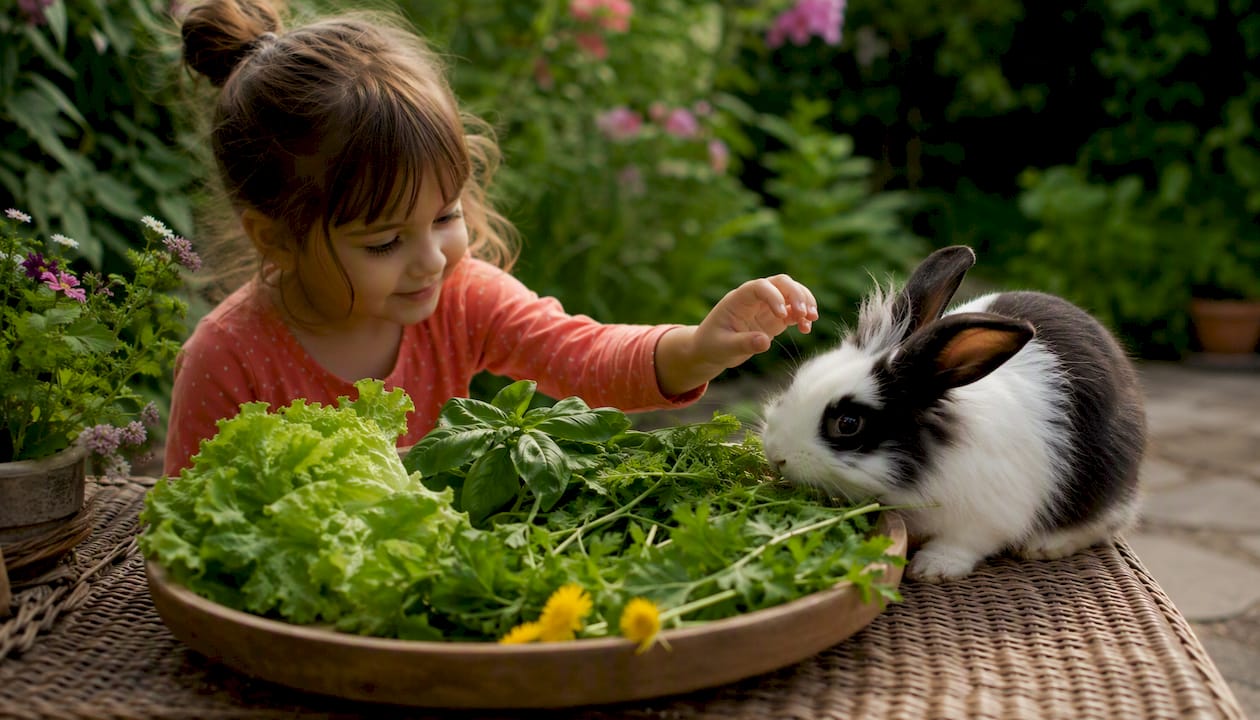
Many leafy greens and garden herbs are safe and genuinely beneficial. High-sugar roots and fruit are treats only. Muesli mixes, chocolate, and several common household plants are unsafe and should never be offered.
Safe foods
Leafy greens (daily, varied):
- Romaine lettuce and other dark leaf lettuces (not iceberg)
- Kale (in moderation — high calcium, so limit to 2–3 times per week)
- Cavolo nero and spring greens
- Watercress
- Rocket (arugula)
- Spinach (limit — high oxalates; offer occasionally, not daily)
Herbs (excellent for variety and enrichment):
- Fresh parsley, basil, mint, dill, coriander, and thyme
- Dried herbs can be scattered in hay for foraging enrichment
Safe weeds from the garden (pesticide-free only):
- Dandelion leaves and flowers
- Plantain (the weed, not the banana)
- Clover (small amounts)
- Chickweed
Vegetables (small portions):
- Broccoli florets (can cause gas in some rabbits — introduce slowly)
- Courgette
- Bell pepper (not the seeds)
- Cucumber
Treats (occasional only — 1–2 tablespoons, once or twice weekly):
- Apple (no seeds or core — seeds contain cyanogenic compounds)
- Strawberry, blueberry, raspberry
- Carrot and carrot tops (the tops are actually the safer part)
- Banana (very small amounts — high sugar)
Foods to avoid
Never offer these to your rabbit: chocolate, avocado, rhubarb leaves, onion, garlic, leek, potato and potato tops, tomato leaves and stems, iceberg lettuce (very high water content, low nutrition, can cause loose stools), seeds and pits of any fruit, bread, pasta, biscuits, or any processed human food. Muesli-style rabbit mixes belong on this list too.
Muesli mixes were originally designed for rapid weight gain in commercial settings, not for long-lived pet rabbits. Rabbits pick out the sweet, starchy pieces and leave the rest, which means they consistently miss key nutrients while loading up on sugar. The result is a well-documented pattern of dental disease, obesity, and gut problems.
High-calcium greens such as kale, spinach, and parsley are safe in rotation but should not dominate the daily mix. Feeding them every day, in large quantities, can contribute to the excess calcium that raises bladder stone risk in adult rabbits.
How to change your rabbit’s diet safely
Transitions must be gradual. The caecum’s bacterial population takes time to adjust to new foods, and rushing the process risks digestive upset that can escalate quickly.
For small changes (introducing a new green or switching pellet brands): 5–7 days
- Days 1–2: Offer a very small amount of the new food alongside the existing diet. Think a single leaf, not a handful.
- Days 3–4: If droppings remain normal and appetite is unchanged, slightly increase the new food.
- Days 5–7: Gradually bring the new food up to the intended portion while reducing the old one.
For switching from muesli to extruded pellets: 2–4 weeks
- Week 1: Replace 25% of the muesli with extruded pellets. Keep hay available at all times throughout.
- Week 2: Move to a 50/50 mix. Monitor droppings daily.
- Week 3: Reduce muesli to 25%, increase pellets to 75%.
- Week 4: Complete the switch to pellets only.
What to monitor throughout any transition
- Droppings: Should be round, firm, and consistent in size. Smaller, fewer, or very soft droppings are a warning sign.
- Appetite: Any reduction in hay intake is worth noting. A rabbit that stops eating hay entirely needs veterinary attention promptly.
- Activity: Lethargy or hunched posture alongside digestive changes warrants a vet call.
- Caecotrope production: You may not see these often (rabbits eat them directly), but a build-up of soft, grape-like clusters around the hutch suggests something is off.
A short bout of softer droppings in the first 24–48 hours of a new food is not unusual. Soft faeces persisting beyond 24 hours, or any sign of abdominal pain, means it is time to call your vet.
When to call your vet immediately:
- No appetite for more than 12–24 hours
- Teeth grinding (a sign of pain)
- Bloated or tender abdomen
- No droppings for more than a few hours
- Soft faeces lasting longer than 24 hours
Use rabbit litter trays to make monitoring droppings easier — a consistent litter area gives you a clear daily picture of what is normal for your rabbit.
Adapting the diet for different life stages and health conditions
Life stage and health status change what your rabbit needs. The core hay-first principle stays constant, but the type of hay, pellet quantity, and greens selection all shift.
Kits and growing rabbits (under 7 months)
Young rabbits have higher energy and protein needs. Alfalfa hay and alfalfa-based pellets are appropriate free-choice until around 7 months, when you should begin transitioning to grass hay and measured adult pellets over 2–4 weeks. Introduce leafy greens gradually from around 12 weeks, one type at a time.
Pregnant and lactating does
Energy and calcium demands increase significantly. Continue alfalfa hay and allow slightly more generous pellet portions during pregnancy and lactation. Return to grass hay and adult portions once kits are weaned.
Overweight rabbits
- Switch to first-cut timothy or another high-fibre, lower-energy hay
- Reduce pellets gradually (never cut them out overnight)
- Increase hay availability and encourage foraging with scatter feeding
- Provide more space for exercise — a secure outdoor run makes a real difference to activity levels
Senior rabbits and those with dental disease
Older rabbits or those with molar spurs and dental problems may struggle to chew coarser hay. Softer orchard grass or third-cut timothy can help. If your rabbit is losing weight or dropping food from their mouth, a dental check is overdue. Your vet may recommend specialist softer forages or supplementary feeding under supervision.
Red flags that need prompt veterinary review:
- Sudden loss of appetite at any life stage
- Rapid or unexplained weight loss
- Persistent soft faeces not linked to a diet change
- Dropping food while eating (a classic sign of dental pain)
A sample daily feeding plan and 7-day greens rotation
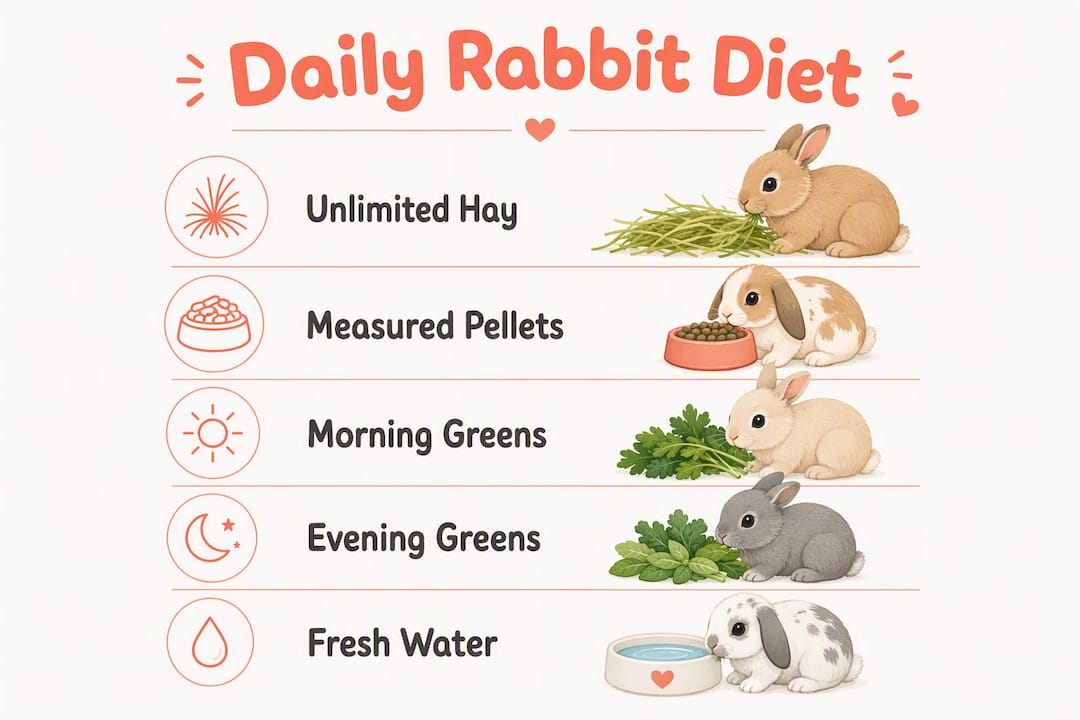
The daily routine is simple once it becomes habit: hay always available, measured pellets in the morning, greens split across two servings, and water checked at both feeds.
Three sample daily menus
Maintenance adult (3 kg rabbit):
- Hay: Unlimited timothy or meadow hay in rack and on floor
- Pellets: 45–60 g extruded pellets, weighed, given in the morning
- Greens (morning): Romaine lettuce, fresh parsley, dandelion leaves
- Greens (evening): Rocket, spring greens, a sprig of fresh mint
- Treats: None today (save for training or enrichment 2–3 times per week)
Overweight adult (3 kg rabbit on a weight-loss plan):
- Hay: Unlimited first-cut timothy (higher fibre, lower energy)
- Pellets: 30–40 g (reduced portion), weighed carefully
- Greens (morning): Romaine lettuce, watercress, fresh coriander
- Greens (evening): Cavolo nero, cucumber, a few dandelion leaves
- Treats: None
Growing kit (3 months old, approximately 0.8 kg):
- Hay: Unlimited alfalfa hay, with a small amount of timothy introduced
- Pellets: Alfalfa-based pellets, free-choice at this stage
- Greens: Introduce one new type per week, very small amounts — start with romaine lettuce
- Treats: None until 12 weeks minimum, and then only tiny amounts
7-day greens rotation (adult rabbit)
Aim for 5–6 different safe greens daily to provide variety and prevent nutritional gaps. Rotate high-calcium greens (kale, spinach, parsley) so they do not appear on consecutive days.
| Day | Morning greens | Evening greens |
|---|---|---|
| Monday | Romaine lettuce, rocket, fresh basil | Spring greens, dandelion leaves, cucumber |
| Tuesday | Watercress, cavolo nero, fresh dill | Romaine lettuce, courgette, chickweed |
| Wednesday | Spring greens, fresh mint, rocket | Watercress, bell pepper, fresh coriander |
| Thursday | Kale (small amount), romaine, dandelion | Cavolo nero, fresh parsley, cucumber |
| Friday | Rocket, spring greens, fresh basil | Romaine lettuce, watercress, courgette |
| Saturday | Spinach (small amount), dandelion, fresh dill | Spring greens, bell pepper, fresh mint |
| Sunday | Romaine lettuce, cavolo nero, fresh coriander | Rocket, watercress, dandelion leaves |
Pro Tip: Wash all greens thoroughly before serving and let them air-dry slightly — a little surface moisture is fine, but soggy greens can cause loose stools in sensitive rabbits. Prep the week’s rotation on a Sunday and store in a sealed container in the fridge to save time.
Scatter feeding — spreading greens and small hay portions around the enclosure rather than placing everything in a bowl — mimics natural foraging behaviour and keeps rabbits mentally stimulated. Pair this with chew and forage enrichment toys to encourage hay consumption between meals.
Buying and storing hay and pellets: what to look for
Buy from trusted suppliers and check every batch before it goes near your rabbit’s hutch. Quality varies more than most owners expect, and a bad bale can cause respiratory or digestive problems before you realise anything is wrong.
Buying checklist for hay
- Colour: green to light green — yellowing or browning suggests age or poor storage
- Smell: fresh, grassy, slightly sweet — never musty or earthy
- Texture: soft and pliable, not brittle or dusty
- No visible mould, dark patches, or foreign material
- Avoid loose hay sold in unsealed bags with no supplier information
Buying checklist for pellets
- Extruded form (uniform pellets, not a mix of shapes and colours)
- Crude fibre content of 18–22% or higher on the label
- Ingredients list led by hay or grass, not grain
- No seeds, nuts, dried fruit, or coloured pieces in the bag
- Clear best-before date with reasonable shelf life remaining
Storing at home
- Hay: breathable hessian or paper bags, or a wooden crate — never sealed plastic
- Pellets: airtight container away from heat and moisture; reseal after every use
- Check both weekly for signs of mould, insects, or unusual smell
- Rotate stock so older supplies are used first
Pro Tip: Buy hay in quantities your rabbit will finish within 4–6 weeks. Larger bales are economical but only worthwhile if you have dry, ventilated storage. Damp hay is not just less nutritious — it can be actively harmful.
Quality red flags to act on immediately:
- Musty or ammonia-like smell from hay or pellets
- Visible white or green mould on hay
- Pellets that have clumped together or smell stale
- Dusty hay that creates a cloud when shaken
When should you call the vet about your rabbit’s diet?
Most dietary adjustments can be managed at home with patience and careful monitoring. Some signs, though, need prompt professional attention.
Seek immediate veterinary care if you notice:
- No appetite for 12–24 hours or more
- Complete absence of droppings for several hours
- Bloated, hard, or visibly distended abdomen
- Teeth grinding or hunched posture (signs of pain)
- Bloody or very dark stools
- Collapse or signs of shock
Contact your vet promptly (same day or next morning) for:
- Soft or mushy faeces persisting beyond 24 hours
- Noticeably reduced appetite or hay intake lasting more than a day
- Significant reduction in droppings without a clear cause
- Unexplained weight loss over days or weeks
- Dropping food from the mouth while eating
What to tell your vet
Keep a brief note on your phone with the following, ready to share at the appointment:
- Current diet: pellet brand and daily gram amount, hay type, greens list
- When the problem started and what changed beforehand
- Description of droppings (size, consistency, frequency)
- Your rabbit’s approximate weight and any recent weight trend
- Photos of droppings if you can take them — vets find these genuinely useful
Key takeaways
A healthy rabbit diet is built on unlimited grass hay (approximately 85% of the diet), with measured extruded pellets at 15–20 g per kg bodyweight per day and a daily variety of 5–6 safe leafy greens.
| Point | Details |
|---|---|
| Hay is non-negotiable | Grass hay should make up approximately 85% of an adult rabbit’s diet — always available, never rationed. |
| Weigh pellets carefully | Feed a maximum of 15–20 g per kg bodyweight per day; topping up bowls freely reduces hay intake and raises obesity risk. |
| Variety in greens matters | Aim for 5–6 different safe leafy greens daily; rotate high-calcium types like kale and spinach to avoid excess. |
| Transitions must be gradual | Switch foods over 5–7 days for small changes, or 2–4 weeks when moving from muesli to pellets. |
| Giddypets supports your feeding routine | Browse rabbit food, treats, and enrichment at Giddypets for vet-backed product choices and practical feeding accessories. |
A note from Giddy
Feeding rabbits well is one of those things that looks simple on paper but trips up even experienced owners — usually because the old advice (a bowl of muesli and a carrot) was so deeply embedded in popular culture. The shift to a hay-first, pellet-measured approach is not complicated, but it does require a small habit change and a kitchen scale.
At Giddypets, we have spent a lot of time curating rabbit supplies that genuinely support this kind of evidence-based care: hay racks that keep forage clean and accessible, enrichment toys that encourage natural chewing, and pellets selected for fibre content rather than palatability gimmicks. Our vet-backed guides and free tools, including the vet finder and feeding checkers on the site, are there to support you when the guidance gets nuanced — because it sometimes does, especially with senior rabbits or those with dental problems.
The most reassuring thing we can tell you is this: if your rabbit is eating plenty of hay, their droppings look normal, and their weight is stable, you are almost certainly doing it right.
Stock your rabbit’s feeding station with Giddypets
Getting the diet right is one part of the picture. Having the right accessories makes it easier to stick to the plan every day.
Giddypets stocks a carefully selected range of rabbit feeding essentials: hay racks and forage mats that keep hay clean and encourage natural foraging, enrichment toys that reward chewing and prevent boredom, and a food and treats range chosen for quality ingredients and appropriate fibre content. Every product in the rabbit range has been selected with the hay-first, vet-backed approach in mind — so you are not sifting through muesli-heavy options or low-fibre pellets.
Browse the full rabbit food and treats range to find pellets, safe treats, and forage accessories suited to your rabbit’s life stage. For enrichment that doubles as dental support, the rabbit toys and chew enrichment section has options that make hay time more engaging for reluctant nibblers.