
Switch your dog's food safely in 7–14 days, UK vet backed schedules
Switch your dog’s food safely in 7–14 days, UK vet backed schedules
Switch your dog’s food gradually over roughly 7 to 14 days, mixing increasing amounts of the new food into the old rather than swapping overnight. Use measured mixing ratios rather than guesswork, and watch stool quality, appetite and energy closely throughout. Slow the pace or pause if you see soft stools that don’t settle; contact your vet promptly for repeated vomiting, bloody or black diarrhoea, or signs of dehydration.
TL;DR:
- The gradual switch over 7 to 14 days helps prevent digestive issues and should be tailored for sensitive dogs, puppies, or those on prescription diets.
- Use measured portions and incrementally increase the new food, with slower progressions of about 10% daily for sensitive or recovering dogs.
- Monitoring stool consistency, appetite, vomiting, and energy levels daily is essential to identify intolerance or serious health concerns early.
- Avoid changing multiple variables at once, and revert to previous ratios or consult a vet if symptoms like vomiting or bloody stool occur.
- Proper tools such as accurate scales, airtight containers, and slow feeder bowls ease the process and improve the chances of a successful transition.
Table of Contents
- When and why you might need to switch your dog’s food
- How to switch dog food safely: schedules and portion sizes
- Monitoring your dog during the transition
- A practical checklist for the switch
- Why gradual transitions actually work
- Where owners go wrong, and how to fix it
- Making the switch easier with the right tools
- Sources
When and why you might need to switch your dog’s food
Most food switches fall into a handful of predictable categories, and knowing which one applies to your dog helps you plan the right pace.
- Life-stage changes — moving a puppy onto adult food, or an adult dog onto a senior formula as their needs shift.
- Weight management — your dog has gained or lost condition and needs a different calorie density.
- Skin, coat or digestive complaints — recurring itchiness, ear infections or loose stools that suggest a food intolerance.
- Vet-prescribed therapeutic diets — for conditions such as kidney disease, allergies or pancreatitis.
- Poor condition or palatability issues — your dog has gone off their current food, or it’s simply not agreeing with them any more.
Puppies typically move onto adult food around one year of age, though timing depends heavily on breed size. Small breeds mature faster and can often switch around their first birthday, while giant breeds have longer skeletal growth and may need puppy food for a longer period.
Some situations call for a chat with your vet before you touch the food bowl at all. If your dog has a history of pancreatitis, chronic gastrointestinal disease, or has reacted badly to food changes before, get veterinary advice first rather than trialling a new diet at home. The same goes for any prescription diet: these are formulated for a specific medical purpose, and switching without guidance can undo the benefit entirely.
How to switch dog food safely: schedules and portion sizes
There isn’t one single correct speed for transitioning your dog’s diet, but there are two well-tested templates that cover almost every situation you’ll encounter.
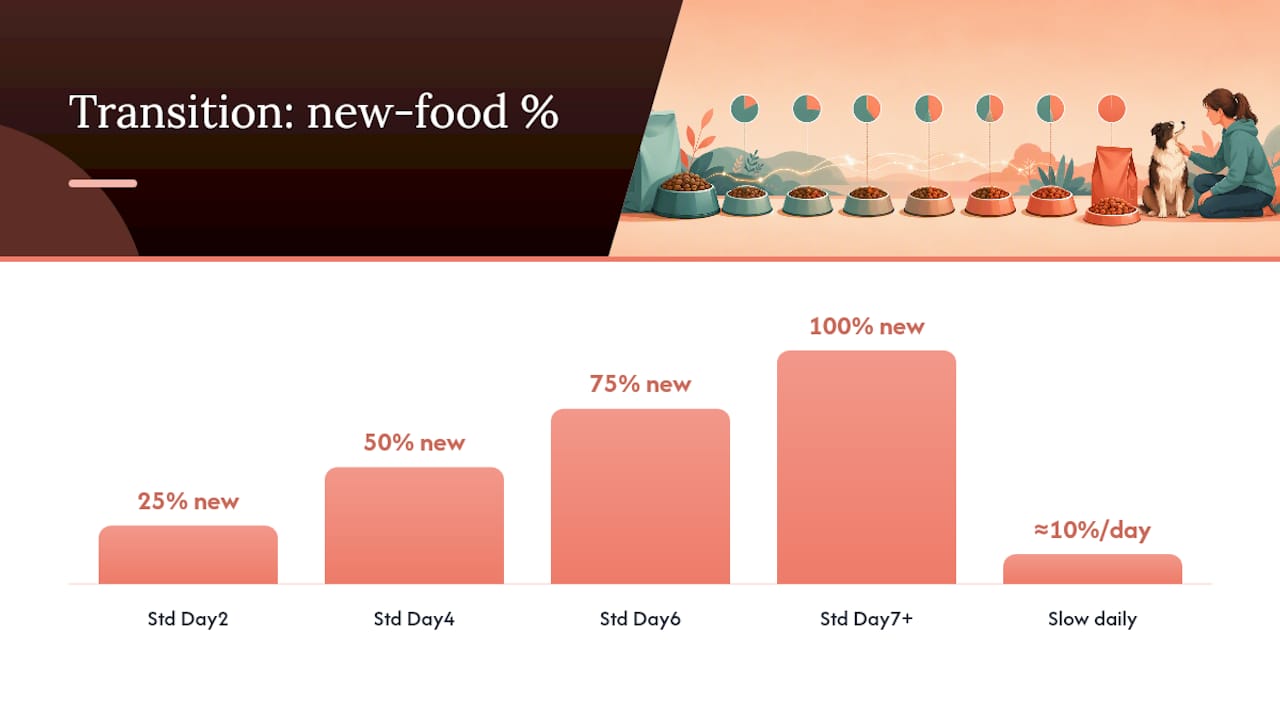
The standard 7 to 10 day ladder suits healthy adult dogs with no history of digestive sensitivity. One widely used version works like this:
- Days 1 to 2: 75% old food, 25% new food.
- Days 3 to 4: 50% old food, 50% new food.
- Days 5 to 6: 25% old food, 75% new food.
- Day 7 onwards: 100% new food.
This mirrors the ratio-based schedule recommended by veterinary nutrition specialists, who suggest replacing around a quarter of the old food with new every second day.
The slower 10 to 14 day ladder is better for sensitive dogs, seniors, puppies, or any switch that involves a bigger jump, such as moving from dry kibble to wet food or changing the main protein source entirely. Instead of jumping in 25% increments, you increase the new food by roughly 10% each day, or by 25% every two to three days. Veterinary guidance consistently points to this longer window for dogs whose digestive systems need more time to adjust.
A worked example makes this concrete. Say your dog eats 300g of their current kibble daily. On day one of a standard switch, you’d feed roughly 225g of the old food alongside 75g of the new. By day five, that flips to 75g old and 225g new. Simple enough, until you factor in calorie density.
Not all dog foods pack the same energy per cup or per 100g. A cup-for-cup swap between two different brands can quietly overfeed or underfeed your dog, because one formula might carry 350 kcal per 100g while another carries 420 kcal. Check the feeding guide on the new packaging and, where possible, weigh portions on a kitchen scale rather than relying on the scoop that came with the old bag. If the new food is notably more calorie-dense, you’ll need to feed a smaller total weight to hold your dog’s calorie intake steady, even while you’re still blending the two.
Pro Tip: Before committing to a full week-long schedule, try a small-bowl test day. Offer a small, measured portion of the new food mixed at a low percentage, perhaps 10 to 15%, and watch how your dog responds over the following 12 to 24 hours. This early check flags an obvious intolerance before you’ve invested a week into a transition that isn’t working.
For puppies moving to adult food, and for seniors moving to a joint-support or lower-calorie formula, stick to the slower ladder as standard. Their digestive systems, and in the puppy’s case their growth requirements, benefit from the extra buffer time.
Monitoring your dog during the transition
Watching your dog’s response day by day is what turns a food switch from a gamble into a controlled process.
Faecal scoring is the simplest tool available to you. Most vets use a scale where a score of 3 to 4 represents a firm, well-formed stool, which is what you’re aiming for throughout the switch. Alongside stool quality, keep an eye on:
- Appetite — is your dog eating with their usual enthusiasm, or picking at the bowl?
- Vomiting frequency — the occasional isolated incident during a switch isn’t unusual, but repeated vomiting is not.
- Energy levels — a dog who’s suddenly lethargic or withdrawn is telling you something.
A single soft stool or a bit of transient gas in the first couple of days is common and usually resolves on its own as the gut adjusts. What warrants immediate concern is different: repeated vomiting, bloody or black, tarry stool, visible abdominal pain, or signs of dehydration such as sunken eyes or tacky gums. Abrupt or poorly managed diet changes are a well-recognised cause of vomiting, diarrhoea and appetite loss, which is exactly why the gradual approach exists in the first place.
Roughly a fifth of dogs show some digestive sensitivity during a diet change, according to faecal scoring guidance used by vets to judge whether symptoms are within the normal range or need attention.
If things go wrong, don’t push through. Pause the transition and revert to the last ratio your dog tolerated well, then hold there for an extra day or two before trying again more slowly. Withhold any treats or toppers during this window, since they muddy the picture and make it harder to pin down what’s actually causing the reaction. If symptoms persist despite slowing right down, an elimination trial or a prescription hypoallergenic diet under veterinary supervision may be the next step to properly identify the culprit.
A practical checklist for the switch
Keeping the process simple reduces the chance of mixed signals and makes it far easier to spot a genuine problem early.
- Measure every meal by weight or the feeding guide, not by eye.
- Note stool consistency once a day, ideally at the same time.
- Keep treats, toppers and chews unchanged for the duration of the switch.
- Check body condition weekly with a gentle rib and waist feel rather than relying on the scales alone.
- If your dog skips a meal or seems reluctant, don’t panic. Offer the usual portion again at the next mealtime rather than topping it up with extras.
- Keep the new food fresh in an airtight storage container, since stale or damp kibble can cause its own digestive upset that muddies your monitoring.
| Situation | What it usually means | What to do |
|---|---|---|
| One soft stool, otherwise normal | Gut adjusting to new food | Continue the current ratio, monitor |
| Repeated vomiting | Intolerance or too fast a switch | Revert to last tolerated ratio, contact vet if it continues |
| Bloody or black stool | Possible serious GI issue | Contact your vet the same day |
| Refusing meals for over 24 hours | Palatability issue or underlying illness | Offer plain portion again; call vet if refusal continues |
Contact your vet immediately if you see abdominal pain, marked lethargy, or any sign of dehydration, regardless of how far into the transition you are.
Why gradual transitions actually work
The reasoning behind the 7 to 14 day window isn’t arbitrary. Your dog’s gut microbiome, the community of bacteria that helps digest food, adapts gradually to a new source of protein, fat and fibre. Change the food overnight and you overwhelm that population before it’s had a chance to adjust, which often shows up as osmotic diarrhoea, where undigested nutrients pull water into the gut faster than it can be absorbed.
Gradual changes over about 10 to 14 days are considered safer for life-stage or prescription diet switches, with stool and behaviour monitoring treated as essential parts of the process rather than an optional extra.
This is precisely the reasoning behind the transition guidance from Vets4Pets, and it lines up with the practical schedules used across veterinary nutrition resources more broadly. If your dog has a known protein sensitivity, our guide to hydrolysed protein diets explains how these specially processed foods reduce the immune response that triggers allergic reactions, which is often the endpoint for dogs who struggle through several failed transitions.
At Giddy pets, every feeding guide and product recommendation we publish is checked against current veterinary nutrition guidance, because a food switch that goes wrong can put a dog off a perfectly good diet for good.
Where owners go wrong, and how to fix it
The single most common mistake we see is impatience. Owners see their dog handle the first couple of days well and jump straight to 100% new food by day four, only to end up back at square one with diarrhoea by day six. The gut doesn’t work on your schedule; it works on its own.
The second mistake is changing more than one thing at once. Switching the main food while also introducing a new topper, a new treat brand, or a dental chew makes it impossible to know what’s actually causing a reaction if one shows up. Keep everything else constant until the new food is fully established.
Ignoring small, persistent changes is the third trap. A slightly softer stool that never quite firms up over two weeks isn’t “just settling in,” it’s a signal worth mentioning to your vet.
If a transition stalls, the fix is usually simple: drop back one step, hold there for two extra days, and cut out anything that isn’t the two foods you’re comparing. Giddy pets helps by pairing every food listing with clear feeding guides, so working out portion sizes and calorie density during a switch doesn’t come down to guesswork.
— Giddy
Making the switch easier with the right tools
Choosing the right new food matters, but so does having the equipment that makes measuring, storing and serving it straightforward. Getting the mixing ratios right depends on accurate portioning, and that’s far easier with the right kit on hand.
Our pet food and treats range is stocked with feeding guides on every listing, so you can compare calorie density between your dog’s old food and any new option before you buy, rather than discovering a mismatch halfway through the transition. If your dog tends to gulp their food and shows more digestive upset than usual during a switch, a slow feeder bowl can ease that, since it slows down eating and reduces the air swallowed with each mouthful. Keeping the new bag sealed properly matters too. Our airtight storage containers keep kibble fresh and free from the damp or pests that can undo a carefully planned transition. Every product comes with vet-approved guidance and fast UK delivery, so you’re never left guessing about portions or timing. Browse the food and treats shop to find the right next step for your dog’s diet today.
Sources
- Switching Pet Foods - Dogs
- How to Switch Dog Foods: Safe Transition Guide | SpectrumCare
- How to transition your dog onto a new food
- How to Switch Dog Foods: Transitioning Your Dog’s Diet