
Overweight cat diet: safe, vet-backed plan for UK owners
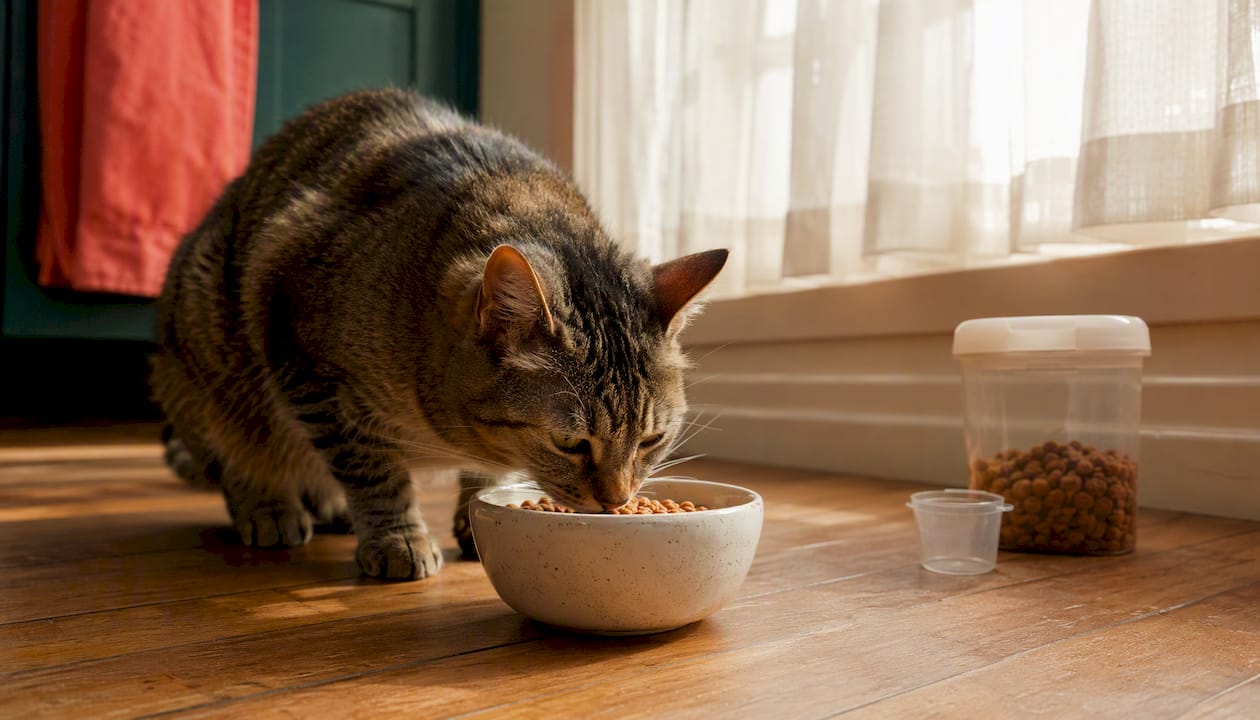
Overweight cat diet: safe, vet-backed plan for UK owners
Your first step is a vet visit, not a new bag of food. Before changing anything your cat eats, you need a confirmed body condition score (BCS) and a documented target weight from your vet. Drastic calorie cuts or home-invented “fad” diets without veterinary oversight carry real medical risks, including a potentially fatal liver condition called hepatic lipidosis.
The plan, in brief:
- Vet check first: confirm BCS, target weight, and rule out medical causes
- Set a calorie target: calculate daily calories based on your cat’s ideal weight, not current weight
- Measure every meal: weigh food in grams on a kitchen scale
- Add enrichment: scheduled play and food puzzles to increase daily movement
- Recheck regularly: weigh your cat every 1–2 weeks and adjust with your vet
Key takeaways
Safe, sustainable weight loss in cats requires a vet-confirmed target weight, a calorie plan based on ideal weight, weighed meals, and regular monitored rechecks throughout the process.
| Point | Details |
|---|---|
| Start with a vet check | Confirm BCS, target weight, and rule out medical causes before changing your cat’s diet. |
| Use the calorie formula | Apply (30 × ideal weight in kg) + 70 to calculate a daily kcal starting point. |
| Weigh every meal in grams | Kitchen scales are more accurate than cups; aim for 0.5%–2% body weight loss per week. |
| Track all treats and extras | Keep treats to 10% of daily calories and subtract them from meal portions to avoid stalling progress. |
| Giddypets supports the plan | Automatic feeders, slow feeders, and interactive toys from Giddypets help make measured feeding and daily activity easier to maintain. |
Table of Contents
- How to assess your overweight cat and why a vet check matters
- How to set a realistic target weight and calorie allowance
- Which foods should you feed an overweight cat?
- Practical portion control: how to weigh and schedule meals
- How to handle treats, snacks and medication food
- Safe ways to increase your cat’s activity
- Feeding in a multi-cat household
- How to track progress and adjust the plan
- Medical risks and when to stop the diet immediately
- A worked example: calories, meals and an 8–12 week starter plan
- Giddy’s perspective: what owners often get wrong about cat weight loss
- Giddypets has the tools to support your cat’s weight-loss plan
- Sources
How to assess your overweight cat and why a vet check matters
A vet visit does far more than confirm what you already suspect. Your vet will assess your cat’s BCS, muscle condition score, body weight, dental health, mobility, and appetite, and will review any medications your cat is currently taking. Some drugs, including steroids and certain antihistamines, contribute directly to weight gain.
Medical causes of obesity are more common than many owners realise. Hypothyroidism, diabetes, chronic pain (which reduces movement), and hormonal imbalances can all drive weight gain or make loss much harder. Your vet may recommend bloodwork or imaging to rule these out before starting any calorie restriction. Starting a diet without this step risks making an undiagnosed condition worse.
Body condition scoring uses either a 5-point or 9-point scale to rate how much fat covers your cat’s ribs, spine, and waist. A score of 3/5 or 5/9 is ideal. Muscle condition scoring is equally important: a cat can carry excess fat while losing muscle, which affects metabolism and recovery. Both scores together give a clearer picture than weight alone.
Ask your vet to document the target weight and set a recheck schedule before you leave the clinic. That written record becomes your benchmark. According to APOP, weight-loss plans should begin with this kind of structured assessment, using measured feeding, treat tracking, and regular rechecks as the backbone of a safe programme.
Pro Tip: Ask your vet to write the target weight and recheck dates on a printed care plan. Pinning it to the fridge keeps the whole household accountable.
How to set a realistic target weight and calorie allowance
Once you have a confirmed target weight, you can calculate a starting daily calorie allowance. The commonly referenced formula is:
(30 × ideal weight in kg) + 70 = kcal per day
This figure is based on your cat’s ideal weight, not their current weight. Using current weight would set calories too high and slow progress. PetMD notes this formula as a widely used starting point, though it should be treated as an initial estimate and adjusted by your vet as the plan progresses.
Worked example: A cat currently weighing 6 kg with an ideal target weight of 4.5 kg. Formula: (30 × 4.5) + 70 = 205 kcal per day. That is the starting daily allowance, split across meals.
Safe weight loss targets, as outlined by VCA Animal Hospitals, involve a gradual percentage of body weight lost per week, with lower rates recommended for morbidly obese cats to reduce the risk of hepatic lipidosis.
How to put this into practice:
- Confirm the ideal target weight with your vet.
- Apply the formula to get a daily kcal figure.
- Start with a modest reduction of 10–20% from the cat’s current intake if the formula result feels too low for your vet’s comfort.
- Convert kcal to grams using the food’s calorie density (listed on the packaging as kcal/100g).
- Weigh every meal on a kitchen scale and record it.
- Adjust upward or downward based on weekly weigh-ins, always with vet input.
Which foods should you feed an overweight cat?
The choice between a veterinary therapeutic weight-loss diet and an over-the-counter (OTC) option is not simply a matter of budget. Therapeutic diets are formulated specifically to reduce energy density while preserving essential nutrients and lean muscle mass. They typically contain higher protein, increased fibre, and concentrated vitamins and minerals, so your cat meets all nutritional requirements on fewer calories. VCA Animal Hospitals explains that these diets are designed so an animal gets what it needs even when total energy is reduced.

OTC “light” or “indoor” foods vary widely. Some are genuinely lower in calories; others differ only marginally from standard formulations. Always check the kcal per 100g on the label and compare it with your cat’s daily allowance.
Wet vs dry food
| Feature | Wet food | Dry food |
|---|---|---|
| Moisture content | 70% | 8–12% |
| Energy density per gram | Lower | Higher |
| Satiety effect | Higher (volume per calorie) | Lower per gram |
| Portion accuracy | Easier to weigh | Easier to measure by weight |
| Hydration support | Contributes to daily fluid intake | Minimal hydration benefit |
Wet food tends to support satiety better because the high moisture content means a larger physical volume for fewer calories. Hill’s Pet notes that weight-control foods often increase moisture or fibre and maintain protein to support satiety while reducing calories. Many cats on weight-loss plans do well on a combination of both formats.
Key macronutrient points to look for:
- Higher protein: preserves lean muscle during calorie restriction
- Controlled fat: fat is calorie-dense at roughly 9 kcal/g, so lower-fat formulas reduce energy density
- Moderate fibre: increases fullness without adding calories
- Lower carbohydrate: cats have limited ability to process high-carb diets efficiently
If your cat refuses the new food, transition gradually over 7–10 days by mixing increasing amounts of the new diet into the current one. If refusal persists, speak to your vet before trying palatability tricks such as warming the food slightly or adding a small amount of low-sodium fish broth. Never add uncounted calories without adjusting the daily total.
Practical portion control: how to weigh and schedule meals
Measuring by cups is not accurate enough for a weight-loss plan. A kitchen gram scale removes that variable entirely. Many vet teams provide a grams-per-day prescription precisely because weight is the only reliable unit, as VCA Animal Hospitals confirms.
Setting up measured feeding:
- Zero the scale with the empty bowl on it.
- Add food until the scale reads the prescribed gram weight.
- Record the weight in a feeding log (a simple notebook or phone note works well).
- Divide the daily gram allowance across two to four meals.
- Set a consistent feeding time and stick to it — cats adapt quickly to routines.
- If using an automatic portion-controlled feeder, calibrate it with the scale first to confirm the dispensed portion matches the target.
Two meals a day is the minimum for most cats on a restricted plan. Four smaller meals can reduce hunger-driven behaviour, though it requires more planning. Timed automatic feeders handle this well if your schedule is unpredictable.
Pro Tip: Weigh a week’s worth of daily portions into small labelled containers on Sunday evening. It takes ten minutes and removes the temptation to “top up” during the week.
How to handle treats, snacks and medication food
Treats are one of the most common reasons weight-loss plans stall. Even small, untracked amounts add up. AAHA is clear on this: record all food, treats, table scraps, supplements, and any food used to disguise medications.
For a cat on 205 kcal per day, that is roughly 20 kcal from treats. Many commercial cat treats contain 2–5 kcal each, so even a handful across the day can eat into the allowance significantly.
How to manage this without cutting treats entirely:
- Subtract treat calories from the daily meal portion. If your cat has 20 kcal in treats, reduce the meal total by 20 kcal.
- Use a small portion of the daily wet food ration as a “treat” rather than buying separate snack products.
- Choose plain cooked chicken breast or a small piece of plain fish as a low-calorie, high-protein alternative to commercial treats.
- Avoid treats with added sugars, gravies, or high-fat coatings.
Medication is a separate challenge. Pill pockets and treat-based medication aids add calories that are easy to overlook. Options include:
- Using a small measured spoon of the cat’s daily wet food ration to wrap a pill.
- Asking your vet about liquid formulations that can be mixed directly into food.
- Consulting your vet if the only workable method adds significant calories, so the daily total can be recalculated.
Safe ways to increase your cat’s activity
Exercise alone will not drive meaningful weight loss in cats the way it does in dogs, but it does support muscle preservation, mental wellbeing, and the overall sustainability of the plan. The goal is to make movement a daily habit, not an occasional event.
- Wand and feather toys: two sessions of 5–10 minutes per day mimic hunting behaviour and get even sedentary cats moving. Play just before meals to replicate the hunt-catch-eat sequence.
- Laser toys: useful for cats who respond to fast movement; always end the session with a physical “catch” (a small treat from the daily allowance or a toy) to avoid frustration.
- Food puzzles and foraging stations: scatter a portion of the daily dry food ration in a puzzle feeder or across a slow feeder to extend eating time and encourage movement.
- Vertical space: cat wall shelves and climbing structures encourage natural jumping and stretching. Even one or two shelves at different heights make a difference for indoor cats.
- Cardboard scratchers and foraging mats: low-cost options that encourage stretching and light activity between play sessions.
For cats with arthritis or limited mobility, keep play at ground level and use slow, gentle wand movements. Short, frequent sessions (three to four minutes, three times a day) are more appropriate than longer ones. Speak to your vet if your cat shows signs of pain during or after activity.
Environmental enrichment and scheduled play make weight-loss programmes more sustainable by reducing boredom-driven eating, as noted in guidance from The Vet Desk.

Feeding in a multi-cat household
Managing an overweight cat’s diet when other cats share the home is one of the trickiest parts of the whole process. Free-feeding becomes impossible, and even well-intentioned owners find that the dieting cat hoovers up a housemate’s portion within seconds.
Practical strategies:
- Separate rooms at mealtimes: feed each cat in a different room with the door closed. Collect bowls after 20–30 minutes so there is nothing left to steal.
- Microchip feeders: these open only for the cat whose microchip is registered to that unit. They are particularly useful when one cat needs a therapeutic diet and another does not.
- Height separation: if one cat is more mobile, feed the non-dieting cat on a raised surface the overweight cat cannot reach.
- Timed feeding windows: structured twice-daily meals replace free access to food for all cats in the household, which also benefits cats at a healthy weight.
- Supervised sessions: stay in the room during meals until you are confident each cat is eating only their own portion.
Microchip feeders work well, but success in multi-cat homes tends to be highest when combined with a consistent routine and room separation during the early weeks of the plan.
How to track progress and adjust the plan
Consistent monitoring is what separates a plan that works from one that drifts. Weigh your cat every 1–2 weeks during the first two months, then monthly once a steady rate of loss is established. Use the same scale, at the same time of day, and record the result every time.
Target rate reminder: aim for 0.5%–2% of body weight lost per week. For a 6 kg cat, that is 30–120 g per week. If loss exceeds 2% per week, reduce calories and contact your vet.
What to record at each weigh-in:
- Body weight in grams or kilograms.
- Estimated BCS (you can learn to do a basic check at home with guidance from your vet).
- Appetite level: eating all food, leaving some, or showing reduced interest.
- Stool consistency and frequency.
- Activity level and general demeanour.
When to adjust the plan:
- Loss too slow (under 0.5% per week for two consecutive weeks): reduce daily calories by a small increment and recheck in two weeks.
- Loss too fast (over 2% per week): increase daily calories slightly and contact your vet.
- No change after three weeks: review treat tracking, confirm gram weights, and discuss with your vet.
- Appetite drops noticeably: stop the diet and contact your vet the same day (see the next section).
As your cat approaches their target weight, the daily calorie allowance will need to increase gradually to a maintenance level. Dropping straight from a restricted diet to ad-lib feeding risks rapid rebound weight gain. Your vet will guide this transition, typically over several weeks.
Medical risks and when to stop the diet immediately
The most serious risk of an overweight cat diet is hepatic lipidosis, commonly called fatty liver disease. When a cat stops eating or loses weight too rapidly, the body mobilises fat stores faster than the liver can process them. Fat accumulates in liver cells, impairing function. Left untreated, it can be fatal.
If your cat stops eating or shows a marked reduction in appetite at any point during the weight-loss plan, pause the diet immediately and contact your vet the same day. Do not wait to see if appetite returns. Early intervention is far easier to treat than established hepatic lipidosis.
Other risks to watch for:
- Muscle loss: inadequate protein or too-rapid restriction can cause lean muscle to break down alongside fat. Higher-protein diets and a gradual rate of loss reduce this risk.
- Nutrient deficiency: cutting calories on a food not formulated for restriction can leave gaps in vitamins and minerals. Therapeutic diets are designed to prevent this.
- Worsening of chronic disease: kidney disease, hyperthyroidism, and diabetes all interact with calorie restriction in ways that require veterinary management.
Red flags that need an urgent vet call:
- Vomiting more than once in 24 hours
- Yellow tinge to the skin, gums, or whites of the eyes (jaundice)
- Lethargy or hiding more than usual
- Weight loss faster than 2% per week
- Any complete refusal to eat for more than 24 hours
The benefits of reaching a healthy weight are well documented, but only when the journey there is managed safely.
A worked example: calories, meals and an 8–12 week starter plan
The cat: Bella, currently 6 kg, ideal target weight confirmed by vet as 4.5 kg.
Step 1: Calculate daily calories (30 × 4.5) + 70 = 205 kcal per day
Step 2: Convert to grams Bella’s wet food contains 85 kcal per 100 g. So: (205 ÷ 85) × 100 = 241 g of wet food per day
Step 3: Divide across meals
Step 4: Treat allowance At roughly 4 kcal per treat, that is a maximum of 5 small treats per day, subtracted from meal portions.
8–12 week check schedule:
- Week 2: first weigh-in. Target: 30–120 g lost. Adjust if outside range.
- Week 4: second weigh-in and BCS check. Review appetite and stool notes.
- Week 6: mid-plan review with vet if possible. Confirm muscle condition.
- Week 8: assess total loss to date. If on track, continue. If plateaued, reduce by 5–10 kcal/day.
- Week 10–12: approach target weight? Begin gradual calorie increase toward maintenance level with vet guidance.
Always confirm this plan with your vet before starting. Individual cats vary, and a vet’s oversight is not optional.
Giddy’s perspective: what owners often get wrong about cat weight loss
Most owners who come to us with a struggling weight-loss plan have the same problem: they are measuring by eye. A generous scoop here, a “small” treat there, a splash of gravy on top because the cat looked unimpressed. None of it is tracked, and none of it is factored into the daily total. The plan looks correct on paper and fails in practice.
The second most common issue is impatience. Owners expect visible change within two weeks and, when the scale barely moves, they cut calories further on their own. That is exactly the wrong response. A plateau in weeks two or three is often the body adjusting, not the plan failing. The answer is to recheck the gram weights, audit the treats, and wait another week before making any change.
What genuinely works is treating this like a medical protocol, not a lifestyle tweak. Weigh the food. Log the treats. Attend the rechecks. Use tools that remove the guesswork: a kitchen scale, a timed feeder, a microchip feeder if you have multiple cats. The cats that reach their target weight are almost always the ones whose owners built a system rather than relying on willpower and good intentions.
One more thing worth saying: enrichment is not optional. A bored, sedentary cat will find ways to demand more food. Play sessions, food puzzles, and vertical space do not just burn a few extra calories. They change the cat’s relationship with food and reduce the obsessive food-seeking behaviour that makes restricted feeding so stressful for everyone in the household.
Giddypets has the tools to support your cat’s weight-loss plan
Getting the right products in place makes measured feeding far easier to stick to. Giddypets stocks a curated range of automatic portion-controlled feeders that dispense precise gram-measured meals on a set schedule, removing the guesswork from twice-daily feeding. Pair one with a set of interactive cat toys and you have the two pillars of a sustainable plan covered: controlled intake and increased activity.

For cats who eat too quickly, slow feeders extend mealtimes and reduce the post-meal hunger signals that lead to begging. Browse the full range of cat food and treats to find lower-calorie options that fit your cat’s daily allowance. All products are available for UK delivery, and every purchase is backed by Giddypets’ vet-approved advice library. Before switching your cat’s diet, confirm the plan with your vet. Products support adherence, but they are not a substitute for veterinary care or a therapeutic prescription diet when one is needed.
Sources
Trusted resources for deeper reading and veterinary references:
- PetMD
- Creating a weight reduction plan for cats | VCA Animal Hospitals
- Feline fitness: how to help your cat lose weight | AAHA
- Weight control food for cats: Key features and feeding tips | Hill’s Pet
Your vet remains the primary source for any individualised guidance. BCS charts and hepatic lipidosis information are available from your veterinary practice or through the VCA and APOP links above.