

Rabbit enrichment ideas to try today
Rabbit enrichment ideas to try today
Here are the rabbit enrichment ideas you can put into practice right now, many of them free or nearly free:
- Toilet-roll puzzle feeder: stuff a cardboard tube with hay and a few dried herbs, fold the ends closed, and let your rabbit work it open.
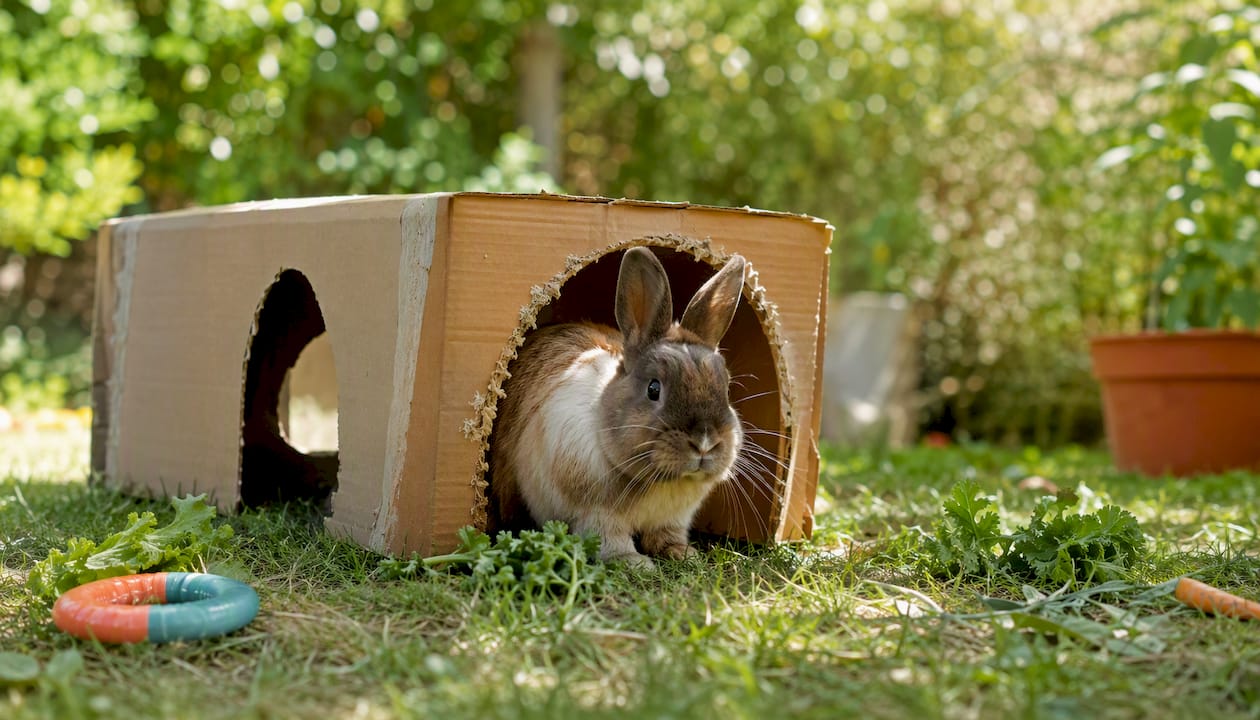
- Cardboard tunnel: open both ends of a large cardboard box or tape two tubes together; rabbits love to run through and hide inside.
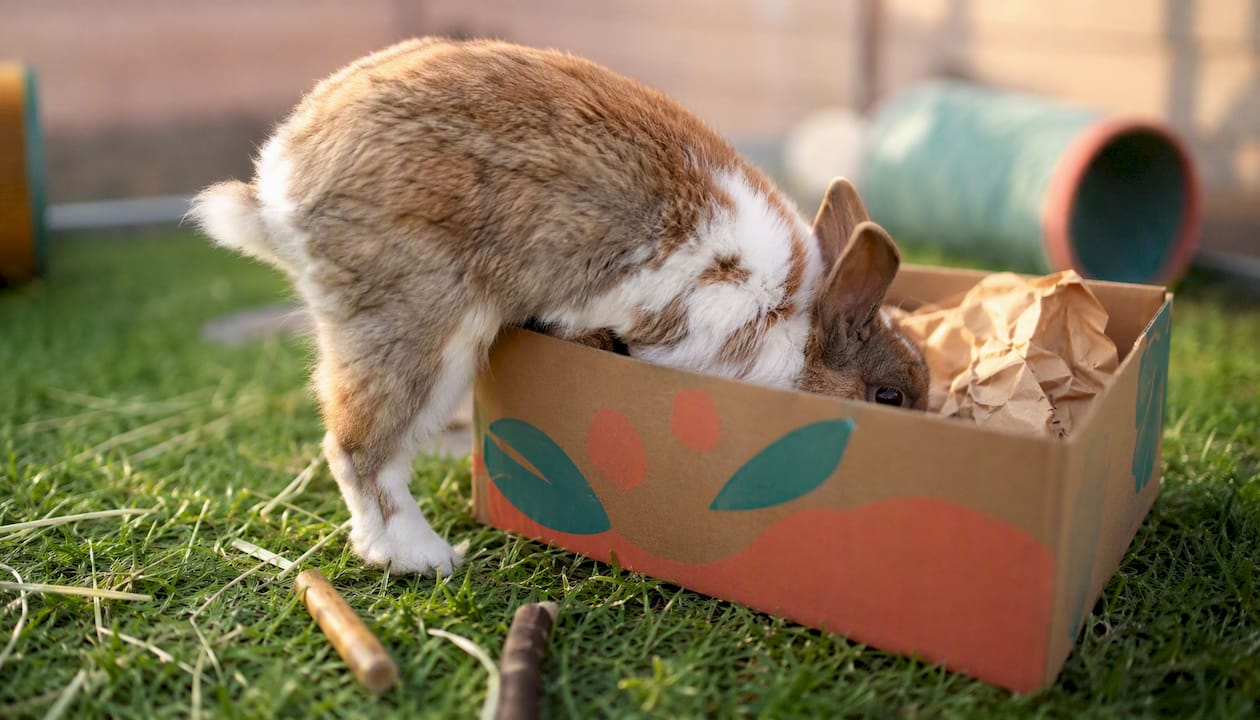
- Hay-filled treat box: pack a small cardboard box with hay and tuck a few safe treats (dried chamomile, a slice of apple) inside for your rabbit to dig out.
- Digging box: fill a deep plastic tray or old litter tray with child-safe sand, soil, or shredded paper and let your rabbit dig freely.
- Hanging vegetable line: thread a piece of safe, natural twine through a leafy green or a slice of pepper and hang it at nose height so your rabbit has to rear up to reach it.
- Low platform: provide a low sturdy platform to give your rabbit somewhere to hop up, survey the room, and hop back down.
- Paper shredding box: drop a few sheets of plain, unprinted paper into a box; many rabbits will shred enthusiastically for twenty minutes.
- Willow ball or apple wood stick: both are safe to chew and cost very little from most pet shops or online.
Safety first: always supervise new items for the first session, use only non-toxic, untreated materials, and remove any small parts that could be swallowed. The House Rabbit Society recommends soy-based-ink paper for dig boxes to keep toxin risk low.
Quick set-up in under ten minutes: for a toilet-roll puzzle, stuff a tube with a small pinch of dried herbs and a few strands of hay, fold both ends inward, and place it in your rabbit’s space. For a basic digging box, fill a litter tray with a few inches of child-safe sand or shredded plain paper and set it in a corner your rabbit already visits.
Key takeaways
Effective rabbit enrichment combines variety across natural behaviours, safe materials, and regular rotation — no single toy or activity is enough on its own.
| Point | Details |
|---|---|
| Start with DIY today | A hay-stuffed toilet roll or a sand-filled tray costs almost nothing and delivers immediate enrichment. |
| Match enrichment to behaviour | Observe what your rabbit does most (digging, chewing, hiding) and prioritise items for that behaviour first. |
| Rotate weekly | Swap items on a weekly schedule to maintain novelty; Sunday is a good day to observe and plan the next rotation. |
| Watch for warning signs | Bar-biting, repetitive circling, or fur-chewing after a week of enrichment changes warrants a vet check. |
| Giddypets for ready-made options | The Giddypets rabbit toys and treats range offers vet-informed, chew-safe products for owners who prefer buying over making. |
Table of Contents
- What is enrichment and why does your rabbit need it?
- Practical rabbit enrichment ideas organised by natural behaviour
- Buy or make: what to look for in safe rabbit toys
- How to use food safely as foraging enrichment
- How to introduce new enrichment and keep it fresh
- Signs that enrichment isn’t working and when to seek help
- Ready-made rabbit enrichment from Giddypets
- Sources
What is enrichment and why does your rabbit need it?
Enrichment means giving your rabbit the physical and mental opportunities to carry out its natural behaviours: foraging, digging, hiding, hopping, rearing up, and socialising. It is not a luxury. The RSPCA advises that a barren environment can cause boredom, frustration, and depression in rabbits, and that hiding places, platforms, toys, and varied feeding methods are all part of meeting their welfare needs.
The practical benefits are real. Physical activity supports healthy muscle tone and gut motility. Chewing on appropriate materials helps wear teeth naturally. Mental challenges reduce the risk of destructive or repetitive behaviours. A rabbit that has enough to do is generally calmer, more curious, and easier to handle.
Watch for early warning signs that enrichment is insufficient: repetitive chewing on cage bars, hunched posture, fur-pulling, or a sudden loss of appetite. These can signal poor welfare rather than illness, though a vet check is always the right first step. More detail on recognising these signs appears later in this guide.
Practical rabbit enrichment ideas organised by natural behaviour
Match enrichment to the behaviour you want to encourage. Rabbits have a repertoire of instinctive drives, and the most effective approach is to give each one an appropriate outlet rather than offering a single toy and hoping for the best. As the Rabbit Welfare Association & Fund notes, a single toy is rarely enough to meet a rabbit’s full behavioural needs.
Foraging
Rabbits spend a large portion of their waking hours searching for food in the wild. Replicate that by making meals a puzzle rather than a bowl.
- Scatter a portion of pellets across a grass mat or hay pile instead of using a dish.
- Stuff hay into a paper bag, scrunch it closed, and let your rabbit tear it open.
- Hide dried herbs (chamomile, dried mint, dried dandelion) inside a cardboard tube or small box.
- Use a puzzle or enrichment feeder to slow down eating and add a mental challenge.
Digging
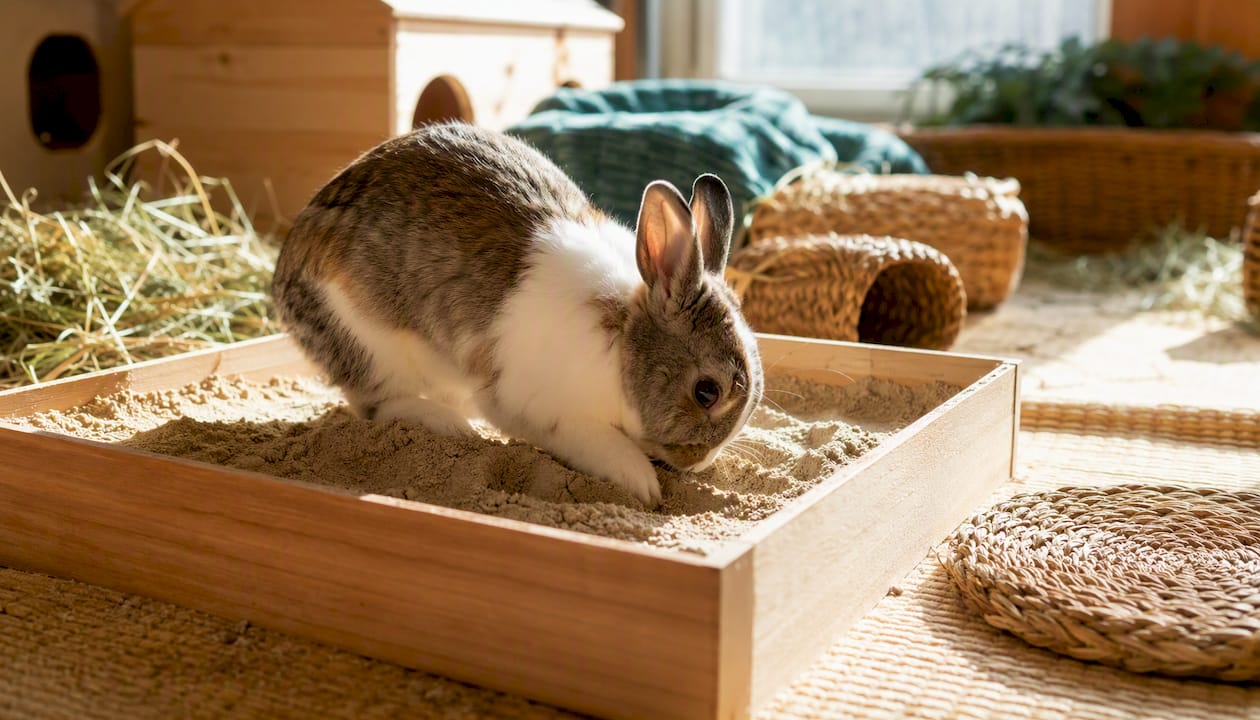
A digging box is one of the highest-impact, lowest-cost additions you can make. Fill a deep tray, a large planter, or a plastic storage box with child-safe sand, organic topsoil, or shredded plain paper. According to the Rabbit Welfare Association & Fund, digging is a core natural behaviour that a barren hutch simply cannot satisfy. Refresh the substrate weekly and check for soiling daily.
Chewing
Chewing is not optional for rabbits; their teeth grow continuously and need wear. Welfare experts are clear that chew toys alone are insufficient without variety in texture and activity. Offer a rotation of:
- Willow balls or rings (widely available and safe to ingest in small amounts).
- Apple wood sticks (untreated; the Pet Vet recommends these for dental and nail-care benefits).
- Dried corn husks or hay cubes for a different texture.
- Compressed hay sticks, which double as a food source.
Hiding and tunnels
Rabbits are prey animals and feel safest when they can retreat quickly. Provide at least one solid hide (a wooden box with a single entrance, or a ceramic pot on its side) and one tunnel. Cardboard tunnels opened at both ends are free to make and easy to replace when chewed through. Place hides in quiet corners rather than high-traffic areas so your rabbit actually uses them.
Platforms and vertical space
Rearing up to survey the environment is a natural behaviour that many hutch setups ignore entirely. A low wooden platform (15–20 cm high) gives your rabbit somewhere to hop up, look around, and jump back down. Sturdy wooden shelves fixed inside a large hutch or run serve the same purpose. Check that any platform has a non-slip surface and no sharp edges.
Social enrichment
Rabbits are social animals and, where possible, benefit from living in a bonded pair. The RSPCA recommends companionship as a core welfare need. If your rabbit lives alone, daily gentle handling and calm, predictable interaction from you matters more than any toy. Clicker training and simple target training also count as social and occupational enrichment: rabbits can learn to touch a target stick, navigate a small agility course, or come when called, all of which build confidence and strengthen your bond.
Sensory enrichment: scent and sound
A room with a view, a window ledge, or a run positioned where your rabbit can watch garden activity provides low-effort visual and auditory stimulation. For scent enrichment, place a small handful of fresh herbs (lavender, rosemary, or dried chamomile) near the hutch entrance rather than inside it, so your rabbit can investigate at its own pace. Avoid strong artificial scents, plug-in diffusers, and loud music near the enclosure. Background sounds at a low volume (speech radio, gentle music) can be positive, but always provide an escape route so your rabbit can move away if it finds the stimulus stressful.
Pro Tip: Watch which activities your rabbit returns to most often in the first week of having new items. A rabbit that repeatedly digs in the corner of its run is telling you a digging box will be a hit; one that chews the hutch bars is asking for more varied chew materials. Let the behaviour guide what you prioritise.
| Natural behaviour | DIY option | Easy buy option | Key safety point |
|---|---|---|---|
| Foraging | Hay stuffed into a cardboard tube | Puzzle feeder or treat ball | Use only rabbit-safe treats; count as part of daily ration |
| Digging | Plastic tray filled with child-safe sand or shredded paper | Digging tray with organic substrate | Avoid chemically treated soil or coloured paper |
| Chewing | Apple wood sticks (untreated) | Willow ball or hay cube | No painted or varnished wood; remove splinters |
| Hiding | Cardboard box with one entrance cut out | Wooden hide or ceramic tunnel | Ensure at least two exits to prevent corner-trapping |
| Vertical space | Stacked wooden boards (non-slip surface) | Wooden platform shelf | Max 20 cm height; check for sharp edges |
| Sensory | Fresh herbs placed near hutch entrance | Herb planter accessible to run | Avoid essential oils, plug-in diffusers, and loud noise |
Buy or make: what to look for in safe rabbit toys
Both buying and DIY work well. The choice comes down to risk, longevity, and how your rabbit interacts with the item. A rabbit that destroys cardboard in minutes is better served by a willow ball that lasts longer; one that ignores shop-bought toys may respond better to a homemade puzzle that smells of familiar hay.
Safe materials to prefer and avoid
Prefer: untreated wood (willow, apple, hazel, birch), plain cardboard without glossy coatings, natural sisal or seagrass, compressed hay products, and plain paper printed with soy-based ink.
Avoid: small plastic parts that can be chewed off and swallowed, cotton string or rope (ingestion risk), painted or varnished wood, rubber components, and any fabric with loose fibres. Check that any commercial toy carries a clear non-toxic label and is sized appropriately so your rabbit cannot get its head stuck.
What to look for in commercial toys
- Sturdy enough to withstand chewing without breaking into sharp fragments.
- Non-toxic finish or no finish at all.
- Chewable textures (wood, wicker, compressed hay) rather than hard plastic.
- Appropriate size for your rabbit’s breed.
- No small detachable parts (bells, plastic beads, metal clips).
Two quick DIY projects
Toilet-roll puzzle: take a used cardboard tube, stuff it with hay and a pinch of dried herbs, and fold both ends inward. Place it in the hutch or run. Total time: two minutes. Replace when soggy or heavily chewed.
Cardboard tunnel: take a large cardboard box (a cereal box works for smaller breeds; a removal box for larger ones), cut openings at both ends, and optionally cut a small side window. Tape any sharp edges flat. Total time: five minutes. Willow sticks and apple wood are available from most UK pet shops and from Giddypets rabbit toys if you prefer a vetted, ready-to-use option.
How to use food safely as foraging enrichment
Use hay-first foraging and reserve treats for puzzle challenges. Food enrichment should be part of your rabbit’s normal daily ration, not an addition to it. The principle is simple: instead of placing pellets in a bowl, hide them, scatter them, or make your rabbit work for them.
Safe foods and treats to use
- Good choices: dried chamomile, dried mint, dried dandelion leaves, small pieces of leafy greens (kale, romaine, fresh herbs), a thin slice of apple (no seeds), or a small piece of carrot.
- Avoid: sugary commercial treats, dried fruit, seeds, nuts, iceberg lettuce, and anything containing artificial flavourings or preservatives.
For a broader guide to safe foods and daily portions, the Giddypets rabbit diet guide is a practical starting point.
Puzzle-feeder progression
Start simple and increase difficulty gradually:
- Level 1: scatter pellets across a hay pile or grass mat.
- Level 2: hide pellets inside a cardboard tube with folded ends.
- Level 3: place the tube inside a closed cardboard box with a small hole cut in the side.
- Level 4: use a commercial treat ball or puzzle feeder that requires rolling or nudging to release food.
Monitor your rabbit’s weight and droppings when you change feeding routines. A sudden drop in droppings or weight loss warrants a vet check rather than a change in enrichment.
How to introduce new enrichment and keep it fresh
Introduce new items slowly and rotate weekly to maintain novelty without causing stress. Rabbits are naturally cautious about unfamiliar objects, a trait sometimes called neophobia. Placing a large new item directly in the centre of the hutch can cause a rabbit to freeze, thump, or retreat for hours.
Introduction checklist
- Place the new item at the edge of the space, not the centre, so your rabbit can approach in its own time.
- Rub the item briefly with a piece of familiar bedding to carry a known scent.
- Allow a short first session (20–30 minutes) and observe from a distance.
- If your rabbit approaches and investigates, leave the item in place. If it thumps, hides, or refuses to move, remove the item and try again the next day with a smaller version.
- Never force interaction. The House Rabbit Society advises that staged introduction with escape routes prevents the kind of stress overload that can set enrichment back by weeks.
For households with more than one rabbit, the RSPCA recommends providing at least one enrichment item per rabbit plus a few spares to prevent guarding and competition.
Sample weekly rotation schedule
| Day | Focus | Example item |
|---|---|---|
| Monday | Foraging | Hay-stuffed cardboard tube |
| Tuesday | Chewing | Fresh willow ball or apple wood stick |
| Wednesday | Digging | Refresh substrate in digging box |
| Thursday | Hiding | New cardboard box hide |
| Friday | Vertical space | Rearrange platform or add a second level |
| Saturday | Sensory | Fresh herbs placed near hutch entrance |
| Sunday | Rest and observation | No new items; note which were used most |
Cleaning and replacement
Inspect all items daily for chewing damage. Remove any item that has broken into sharp fragments or small ingestible pieces. Wash hard toys with plain warm water (no detergent) weekly. Replace soft fabric items if chewed, as loose fibres are an ingestion risk. Cardboard and paper items can simply be replaced with fresh ones when soiled or destroyed.
Signs that enrichment isn’t working and when to seek help
Look for changes in posture, repetitive behaviours, appetite, or toileting. These can signal poor welfare and should not be dismissed as personality quirks.
Common signs that your rabbit needs more or different enrichment include:
- Bar-biting or cage-chewing: often a sign of frustration rather than hunger.
- Repetitive circling or pacing: a stereotypy that indicates chronic boredom.
- Fur-chewing or over-grooming: can be behavioural but always rule out skin conditions first.
- Hunched posture with eyes half-closed: may indicate pain, illness, or depression.
- Loss of appetite or reduced droppings: always a reason to contact a vet promptly.
- Destructive chewing beyond normal levels: especially if directed at the same spot repeatedly.
If you notice one or more of these signs, try the following in order. First, add one new enrichment item and observe for 48 hours. Second, increase space if possible, such as by adding a secure outdoor run or expanding the indoor area. Third, if behaviours persist after a week of enrichment changes, contact your vet to rule out medical causes (dental pain, gut issues, or skin conditions can all mimic boredom behaviours). If the vet finds no physical cause, ask for a referral to a rabbit behaviourist registered with the Animal Behaviour and Training Council (ABTC).
When you contact the vet, note when the behaviour started, how often it occurs, any recent changes to diet or housing, and which enrichment items your rabbit currently has access to. This information helps the vet distinguish between a welfare issue and an underlying health problem.
A note from Giddy
The cheapest enrichment wins more often than you’d expect. A toilet-roll stuffed with hay and a pinch of dried chamomile consistently gets more attention than a shop-bought toy left in the same spot for a month. The key is rotation and observation: watch what your rabbit actually does, not what you think it should enjoy. New items always need supervision for the first session, and the simplest rule is this: if it smells interesting and can be chewed safely, your rabbit will probably love it.
Ready-made rabbit enrichment from Giddypets
If DIY isn’t your preference, or you want to complement your homemade items with something more durable, choosing the right ready-made products makes a real difference to how much your rabbit engages with them.
Look for forage toys, treat-dispensing balls, safe chew sticks (willow or apple wood), low wooden platforms, and digging trays made from non-toxic materials. Giddypets stocks a curated range of rabbit chew and forage toys that are selected with welfare in mind, alongside rabbit-safe treats and foraging toppers that work perfectly inside puzzle feeders or stuffed tubes. Every product listed is chosen to support natural behaviours rather than simply to entertain.
Transparency note: Giddypets is the publisher of this article and sells the product types recommended here. The guidance throughout this piece is based on welfare charity and veterinary sources; product recommendations reflect those standards.
Browse the Giddypets rabbit toys range to find your next enrichment addition, or check the rabbit-safe food and treats section for foraging-ready options you can use this week.
Sources
The sources below are the most reliable starting points for rabbit welfare guidance in the UK and beyond. The Rabbit Welfare Association & Fund and the RSPCA both publish charity-reviewed, practical advice aligned with current UK welfare standards. The House Rabbit Society provides detailed DIY enrichment tutorials. Agriculture Victoria’s enrichment framework is a useful structured reference for owners who want to build a more formal enrichment plan.
- Rabbit housing enrichment — Rabbit Welfare Association & Fund
- Enriching your rabbits — RSPCA
- Homemade Enrichment Ideas — House Rabbit Society
- Rabbit
- Keeping your rabbit entertained — The Pet Vet